When you hear the word “mochi,” Japan’s famous sticky rice cakes probably come to mind. But did you know that the exact same sound, “mochi,” exists as a completely different word in the Japanese language? Furthermore, the idiomatic expressions derived from each “mochi” carry entirely distinct cultural nuances.
While navigating these identical sounds can be tricky for learners, it is also what makes Japanese so fascinating. Let’s explore the world of “mochi” through a short story.
Summary
- The Two “Mochi”s: In Japanese, the food “Mochi” (餅) and the grammatical derivative of the verb meaning to possess or hold, “Mochi” (持ち), share the exact same pronunciation.
- Idiomatic Expressions: Idioms containing “mochi” are derived either from the physical properties of the rice cake or from the concept of ownership and possession.
- Characters
- Prologue
- The Meanings and Idioms of “Mochi” (餅) and “Mochi” (持ち)
- The Secret to Mastering Japanese Expressions
- From my personal experience
- Conclusion
Characters
- Mike: A 12-year-old American boy interested in Japan.
- John: Mike’s father. He frequently visits Japan for business.
- Kelly: Mike’s mother. She is good at cooking.
- Nobu: A Japanese international student.(This character represents and speaks for the author’s personal experiences and opinions)
Prologue
Japanese is full of homophones—words that sound exactly the same but have different meanings. For many learners, this can feel like a major hurdle, or perhaps a bit of a linguistic wordplay game.
Today, we are looking closely at “mochi.” While their origins and expressions are completely distinct, how exactly do they differ?
The Meanings and Idioms of “Mochi” (餅) and “Mochi” (持ち)
Mike: “Dad, it’s amazing how many Japanese words sound exactly the same but mean completely different things.”
John: “That’s very true, Mike. Take the word ‘kau,’ for example. In one context, it means ‘to buy,’ but in another, it means ‘to keep a pet.’ The kanji characters are completely different, but the spoken pronunciation is identical. It can get pretty confusing.”
Mike: “Exactly! I started noticing this after I learned about ‘mochi,’ the rice cakes Japanese people eat during New Year’s… Hey, let’s ask Nobu about it!”
(Nobu walks into the living room)
Nobu: “Hello, everyone!”
John: “Ah, Nobu! Perfect timing. We were hoping you could help us solve a quick Japanese language puzzle.”
Nobu: “Sure! What’s on your mind?”
Mike: “We know ‘mochi’ is a food, but we also heard it has something to do with owning things. Could you explain the difference between the two?”
Nobu: “Aha! The classic tale of two mochis. Happy to help break it down for you.”
Part 1: A Review of Food “Mochi” (餅)
Nobu: “First, let’s look at the edible Mochi (餅).”
Kelly: “Ooh, the rice cakes! I’m all ears.”
1. Made from Glutinous Rice
Nobu: “Mochi is a traditional food made from mochigome (glutinous rice). It’s a completely different variety of rice compared to the standard white rice eaten with daily meals. It has a uniquely sticky, stretchy, and chewy texture.”
Kelly: “Ah, so it’s not just regular cooked rice mashed up.”
Nobu: “Exactly. To make it, the glutinous rice is steamed, placed into a traditional wooden or stone mortar called an usu, and repeatedly pounded with a heavy wooden mallet called a kine. You can picture it like driving a stake into the ground with a massive sledgehammer.”
2. A Beautiful, Pure White Appearance
Nobu: “Another defining characteristic of mochi is its beautiful, snowy white color. If you look closely at traditional Japanese ingredients, quite a few aren’t historically prized for their visual elegance alone. Root vegetables like daikon radishes and sweet potatoes are caked in dirt, and many fish aren’t exactly what you’d call ‘pretty.’ Even rice was historically consumed as brown rice (genmai), which looked very different from modern polished white rice.”
Kelly: “But mochi stood out as an exception?”
Nobu: “I believe so. Because it is so purely white and beautifully soft, it historically held a special, almost sacred status compared to everyday foods.”
3. The Magic of Puffing Up When Cooked
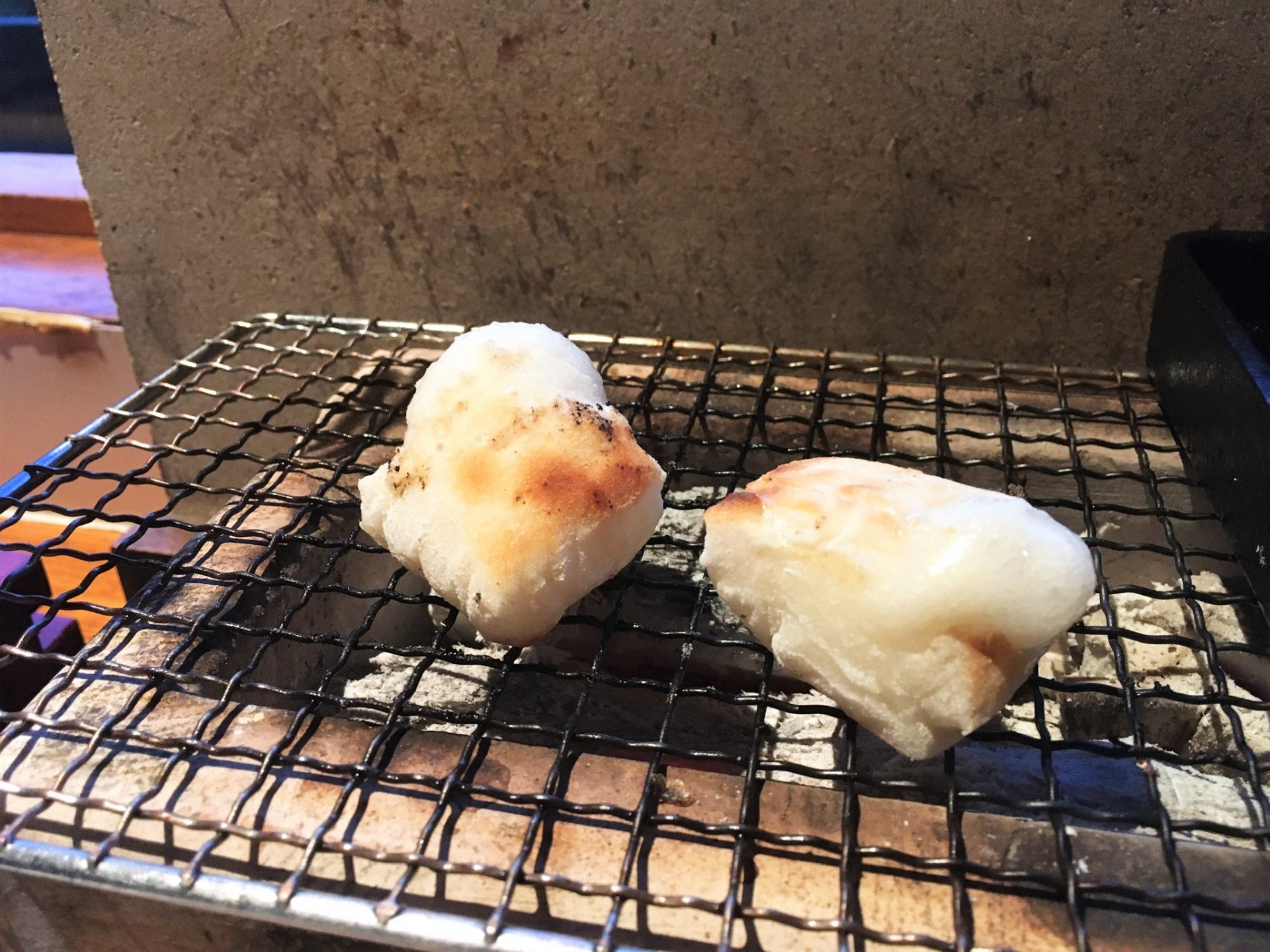
Nobu: “Mochi also has a unique property: it expands dramatically when heated. If you take a pre-cut hard block of dry mochi and grill it over a burner, the inside heats up and it suddenly puffs up like a balloon. In Japan, you generally tell if a rice cake is perfectly cooked based on how much it has puffed out.”
Kelly: “How big does it actually get?”
Nobu: “Surprisingly big! It bubbles right up, so you can’t miss it.”
Idioms Derived from Food “Mochi”
Nobu: “Because of these physical traits, the food ‘mochi’ has inspired several common Japanese idioms.”
Mochi-hada (もち肌) – Mochi Skin
Nobu: “First is ‘Mochi-hada.’ This expression is used to praise someone’s exceptionally beautiful skin—especially women’s. Because fresh mochi is flawlessly white, smooth, and has a lovely, bouncy elasticity when touched, it represents the absolute gold standard for beautiful skin.”
John: “Ah, so it describes skin that is as pale, smooth, and soft as a fresh rice cake.”
Nobu: “Precisely. It’s an idiom born directly from the visual and tactile qualities of the food.”
Yakimochi wo yaku (やきもちを焼く) – To Grill Mochi (To Be Jealous)
Nobu: “Next up is ‘Yakimochi wo yaku.’ In practice, this idiom means ‘to be jealous’ or ‘envious.’ For example, if a girl gets upset because the guy she likes is talking to someone else, she is said to be ‘grilling a yakimochi.'”
Mike: “Wait, why does grilling a rice cake mean jealousy?”
Nobu: “Think back to what happens when you grill a mochi—it swells and puffs up. The idiom comes from the image of a jealous person puffing up their cheeks in a pout or blowing up with anger.”
Mike: “Oh, that makes sense! They literally ‘swell up’ with anger.”
Nobu: “Exactly. In fact, the word ‘to swell’ (fukureru) is often used on its own in Japanese to mean someone is sulking or pouting.”
Shirimochi wo tsuku (尻もちをつく) – To Pound a Mochi on One’s Butt (To Fall Flat on One’s Behind)
Nobu: “Finally, we have ‘Shirimochi wo tsuku.’ This means to lose your balance, fall backward, and land hard right on your backside. The phrase comes directly from the rhythmic, heavy thudding sound of the kine mallet hitting the mortar during a mochi-pounding ceremony (mochitsuki). The way someone falls heavily onto their rear end reminded people of that striking motion.”
Mike: “Wow, what a vivid image!”
Part 2: A Review of Possessive “Mochi” (持ち)
Nobu: “Now, let’s shift gears to the other Mochi (持ち).”
The Multi-Talented Verb “Motsu”
Nobu: “It’s quite common for a single word to carry multiple meanings, and the Japanese verb ‘motsu’ (持つ) is a prime example. On one hand, it means a physical action: ‘to hold’ or ‘to carry’ something in your hand, like a bag.”
John: “Okay, that’s straightforward.”
Nobu: “But on the other hand, ‘motsu’ also means ‘to possess’ or ‘to own’ something. In English, you might use specific words like hold, grab, or own, and you rarely swap them around casually. In Japanese, however, we use the exact same root verb. The noun form, ‘mochi,’ describes the ongoing state of maintaining that possession.”
John: “I see. So it refers to an ongoing state of ownership.”
Idioms Derived from Possessive “Mochi”
Nobu: “Let’s look at how this version of ‘mochi’ attaches to other words to form descriptive idioms.”
Kane-mochi (金持ち) – Wealthy / Rich
Nobu: “First is ‘Kane-mochi.’ This is the Japanese equivalent of a ‘rich person.’ It literally translates to ‘money-possessor’—someone who maintains a large ownership of financial wealth. By the way, if someone is incredibly wealthy, we call them an ‘Ō-kane-mochi’ (Big Money Possessor).”
John: “Ah, so it’s literally describing the state of holding onto money.”
Chikara-mochi (力持ち) – Strong Man / Powerful
Nobu: “Next is ‘Chikara-mochi,’ which means a physically strong or powerful person. The ‘mochi’ here means they ‘possess strength.’ Because they own immense physical power, they are labeled a strength-possessor.”
John: “That makes total sense. A possessor of might.”
Byōki-mochi (病気持ち) – Having a Chronic Illness
Nobu: “Lastly, there is ‘Byōki-mochi.’ This describes someone who suffers from a chronic health condition or long-term illness. The linguistic concept here is that the person ‘possesses an illness’ or is carrying a medical condition with them over time.”
John: “Wow, Japanese really views ownership through a broad lens, doesn’t it?”
The Secret to Mastering Japanese Expressions
John: “Nobu, this has been incredibly eye-opening, but it also highlights how complex Japanese can be. What’s the best way for a foreigner to actually learn and remember all of this?”
Nobu: “It’s a tough question, John. Honestly, I think it requires moving past simple vocabulary drills. You can’t just treat it as a language study.”
John: “You mean language fluency isn’t enough on its own?”
Nobu: “Exactly. For instance, if you don’t know what a traditional rice cake looks or feels like, the phrase ‘mochi-hada’ (mochi skin) won’t make any sense. If you’ve never witnessed the heavy, booming rhythm of traditional mochi pounding, visualizing ‘shirimochi’ (falling on your rear) becomes incredibly difficult.”
John: “So, to truly understand the language, you have to absorb the lifestyle and cultural traditions behind it?”
Nobu: “Rote memorization can only get you so far. Without a foundational understanding of Japanese daily life and culture, mastering these expressions is an uphill battle.”
John: “I guess that means living in Japan really is the ultimate shortcut!”
Nobu: “It absolutely is!”
End
From my personal experience
Thinking back to my own days studying English, I vividly remember how brutal it was to navigate words that looked almost identical but meant entirely different things. A prime example for me was wrestling with words like “expression,” “explain,” and “experiment.” I used to sit at my desk wondering, “They all start with ‘ex,’ so why on earth are they so completely different?!” Struggling through those nuances was incredibly frustrating—especially knowing my university entrance exams rode directly on getting them right.
I am certain that people learning Japanese from overseas experience this exact same headache. In the area where I live, I see many foreign residents, and I often wonder if they are hitting the exact same linguistic walls. It’s undeniably tough, but pushing through it is the only way forward. To everyone out there studying hard: keep going, you can do it!
Conclusion
We have looked at the fascinating divide between the two faces of “mochi” in the Japanese language: the delicious New Year’s treat (餅) and the grammatical concept of possession (持ち). While they look completely identical when written out in the Roman alphabet, peering behind the curtain reveals a profound depth tied directly to Japan’s cultural history.
Discovering just how deeply language is intertwined with daily cultural practices might feel a bit overwhelming if you are currently studying Japanese. However, while this hidden complexity makes Japanese challenging, it is also precisely what makes the language so deeply rewarding and beautiful. Don’t just memorize the vocabulary—embrace the culture, traditions, and daily life that give the words their meaning!