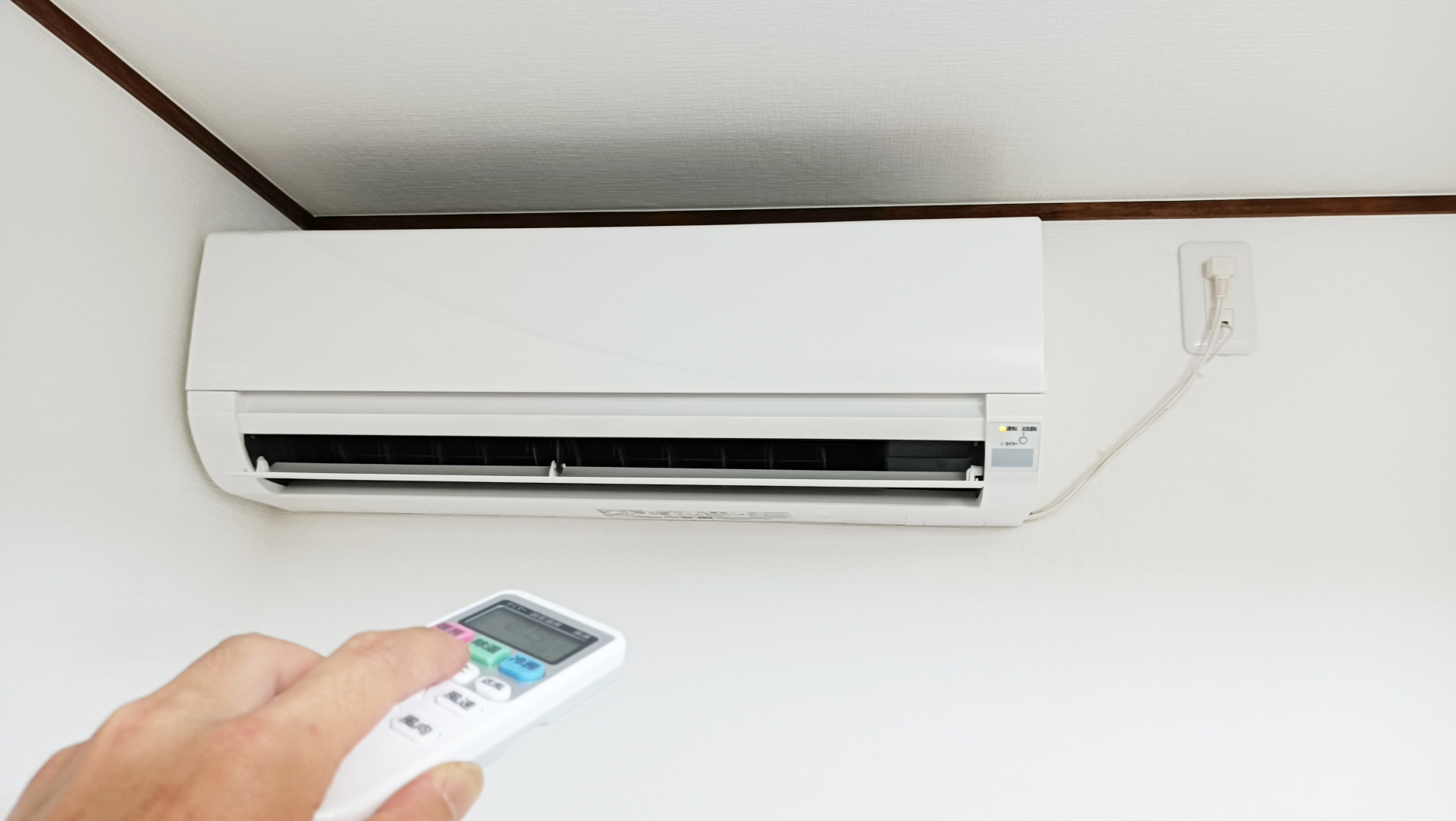
Japanese summers are not only hot but also extremely humid, making them highly uncomfortable. Especially with the recent rise in temperatures, the heat has become severe, and it is not uncommon for people to suffer health issues.
An air conditioner is essential to survive this, but those who have recently arrived in Japan might feel lost on how to buy one.
Therefore, in this article, I would like to share the key points to look out for when buying an air conditioner, based on my own experience, in a story format. …By the way, please take the lines of “Nobu” in the story as personal advice from my own experience.
Summary
- Choose the right cooling capacity based on your room size. Compare old and new models for price and efficiency differences.
- Check installation requirements, voltage, and space for the outdoor unit.
- Ask about installation fees and after-service at the store.
- Reduce noise by placing the outdoor unit properly and using vibration pads.
- Test the AC before summer and clean filters regularly.
Characters
- Mike: A 12-year-old American boy interested in Japan.
- John: Mike’s father. He frequently visits Japan for business.
- Kelly: Mike’s mother. She is good at cooking.
- Nobu: A Japanese international student.(This character represents and speaks for the author’s personal experiences and opinions)
Prologue
John is an American businessman, and this time, one of his colleagues is transferring to Japan. The accommodation will be a rental apartment in the Tokyo metropolitan area. Naturally, things are different compared to America.
Right around the time his colleague was about to come to Japan, they heard about how harsh the Japanese summer is. Since John had experience visiting Japan, his colleague asked him for advice. However, although John has been to Japan, he doesn’t have experience staying long-term. So, he decides to ask Nobu for advice.
Characteristics of Japanese Air Conditioners
John: “I heard that summer in Japan is brutal. Could you tell me how to choose an air conditioner or what to watch out for?”
Nobu: “Yes, with pleasure. …First, I think it’s important to understand the characteristics of Japanese air conditioners.”
John: “I see, that makes sense.”
Basically Installed on a Room-by-Room Basis
Nobu: “Air conditioning can either be done for the whole building at once or on a room-by-room basis, but Japanese housing basically does it room by room. Therefore, for example, if it’s a 4LDK property (4 rooms + Living/Dining/Kitchen), there are 4 rooms plus a kitchen, so you would need 5 air conditioners.”
John: “I see. Then we have to think about it for each room individually, right?”
Nobu: “That’s right. You should think on a room-by-room basis. For example, if you go to an electronics retail store and look at the capacity of air conditioners, you’ll find labels like ‘For 6 tatami mats (六畳用)’ or ‘For 8 tatami mats (八畳用)’. This description shows the room size it covers. If you buy a 6-mat version for a large room, it will consume unnecessary energy, and if you buy an 8-mat version for a narrow room, it will be over-specified. That’s why you should check the size of the room before choosing and installing one.”
John: “So central air conditioning isn’t completely zero, right?”
Nobu: “They do exist, but it would be for detached houses.”
Basically Wall-Mounted Type
Nobu: “Also, air conditioners are basically wall-mounted types. If you go to the air conditioner section of a store, you’ll see them lined up all over the walls.”
John: “If it’s wall-mounted, won’t the installation work be difficult?”
Nobu: “True, the installation work is tough. However, since an electrician does the work, there is no problem.”
John: “Is it not allowed to do the installation work yourself?”
Nobu: “Air conditioner installation sometimes involves changing the indoor wiring. Therefore, it must be done by a qualified person. No matter how confident you are in electrical work, it breaks the law, so let’s leave it entirely to the professionals.”
There are 200-Volt and 100-Volt Models
Nobu: “Furthermore, some air conditioners use a 200-volt power supply, and others use 100 volts. The 200-volt ones are high-power. If you are installing it in a large room, I think it will be a 200-volt model.”
John: “I see. High output sounds reliable.”
Nobu: “By the way, it is essential to check the wall outlets before purchasing. Even if you go through the trouble of buying it, you’ll be in trouble if the power supply doesn’t match.”
John: “That’s certainly true.”
Operated by Remote Control
Nobu: “Also, Japanese air conditioners are operated by remote control.”
John: “Well, that makes sense.”
Nobu: “However, unlike TVs and such, there are cases where operation can only be done via the remote control. Therefore, you must be very careful not to break or lose it.”
John: “If you unplug the air conditioner from the wall outlet, it will probably stop, so wouldn’t that prevent it from becoming a big problem?”
Nobu: “But even if you plug it back in, you might not be able to start it up next time. Either way, you need to be careful with how you handle the remote control.”
How to Choose an Air Conditioner
Nobu: “Next, let me introduce how to choose an air conditioner.”
Mike: “I wonder what kind of functions they have?”
About Air Conditioner Capacity (Corresponding Tatami Mats)
Nobu: “The first thing to mention is ‘air conditioner capacity’ (corresponding number of tatami mats). The output of Japanese air conditioners changes depending on the size of the room. You install a high-output one in a large room, and a not-so-high-output one in a narrow room.”
John: “Room size… isn’t that difficult?”
Nobu: “Basically, room sizes in Japan change based on the number of tatami mats, so if you check the area of the room, there is no problem. However, Western-style rooms with flooring cannot be calculated by the number of tatami mats, so a conversion into square meters will be necessary. Also, it differs depending on whether it is a reinforced concrete structure like an apartment or a wooden detached house.”
John: “What should we do in that case?”
Nobu: “If you measure the rough dimensions of the room, calculate the area, and consult with the store clerk about whether it is reinforced concrete or a detached house, they will propose one with the appropriate output.”
John: “I see.”
About Functions
Nobu: “Next is the functions of the air conditioner, but since this ties into the price, it’s better to think about what functions you need beforehand.
John: “What are the necessary functions?
Nobu: “To give a rough outline, they are cooling/heating, dehumidifying, air purifying, and auto-cleaning. If you go high-spec, functions are added, but if you go low-spec, it becomes cheaper but functions are cut.”
John: “I wonder which is better.”
Nobu: “This is strictly based on my own experience, but I recommend the high-spec ones with more functions. The reason is, for example, during pollen season, the need for air purification arose for me. Also, I couldn’t get around to cleaning it very often. I regretted it, thinking, ‘I wish I had an auto-cleaning function’. Functions that seem over-specified at first glance can actually turn out to be indispensable later on, and you only realize it afterward.”
John: “I see, so you felt that over-specified was better.”
Nobu: “Also, you need to be careful depending on the heating output. This is because Japan has many cold regions, and in such areas, there are cases where the air conditioner is used as the main heating system.”
John: “I see.”
Nobu: “However, this is strictly case-by-case. It’s necessary to summarize the functions you want first and consult with the store clerk.”
About Energy Efficiency
Nobu: “You also need to consider energy efficiency. This is because the recent hikes in electricity bills have been incredible.”
Kelly: “Electricity bills directly impact the household budget.”
Nobu: “Exactly. That’s why it’s good to check the electricity consumption before purchasing. By the way, some electronics retail stores display an estimate of the annual electricity cost. It’s good to use that as a reference for choosing a model.”
Check Multiple Electronics Retail Stores
Nobu: “Next, regarding how to buy an air conditioner, the basic rule is to check multiple electronics retail stores.”
John: “Why is that?”
Nobu: “Because the types of air conditioners they have in stock can be different.”
John: “I see. If you look at multiple retail stores, you can check that many more models, right?”
Nobu: “That’s part of it, but it also allows you to compare prices. What’s more, some electronics retail stores will offer discounts if another company is cheaper. If you are thinking about getting a discount, you should definitely check multiple stores.”
John: “I see.”
Nobu: “Also, installation costs might be separate, so sometimes you need to calculate the total estimate. Instead of just comparing product prices, you also need to examine the total cost. That’s why checking multiple stores is necessary.”
John: “I see, is that so?”
Nobu: “In addition, you can buy air conditioners online, but I have doubts about this. This is because it’s easy to overlook the output and functions. …However, there are people who are good at shopping online, so please just take this as ‘my personal opinion’.”
About Cost
Nobu: “You also need to check the cost. Basically, I want to recommend high-spec products, but there will be people who want to prioritize the upfront cost.”
John: “Yes. Price is important.”
Nobu: “That’s exactly why I think it’s necessary to check multiple products. However, in that case, I believe you should also factor in the electricity bills.”
Kelly: “If electricity bills are high, that’s certainly true.”
About Manufacturers
Nobu: “Lastly, the manufacturers. Since multiple manufacturers release air conditioners, a comparison between manufacturers is also necessary.”
John: “I see, then which manufacturer is good?”
Nobu: “That is extremely difficult. Because different manufacturers have different specialties. It ranges widely, from manufacturers that focus heavily on specs to those that focus on cost.”
John: “But Nobu, you must have chosen one before yourself.”
Nobu: “Yes. I chose a mid-spec model from a company known for good cost-performance. …However, as I mentioned earlier, I regret that I limited the functions too much.”
Other Points
John: “Is there anything else?”
Nobu: “Let’s see… “
For Rental Properties, Consult the Landlord
Nobu: “In the case of rental properties, you must consult with the landlord.”
Kelly: “Do we have to ask permission every single time?”
Nobu: “Legally speaking, you have to return rental properties to their original state when you leave. Basically, recovery from deterioration due to normal use is covered by the owner, but defects caused by negligence are borne by the tenant. To install an air conditioner, you sometimes have to drill a hole in the wall, and that part can become a subject of dispute. To avoid trouble, consultation is necessary.”
Kelly: “I see, returning it to how it was. That sounds unexpectedly troublesome.”
Measures Against Noise and Vibration
Nobu: “Also, you need measures against noise and vibration.”
John: “Noise and vibration… that’s a headache of a problem, isn’t it?”
Nobu: “Yes, it is. This surprisingly becomes a seed for arguments.”
John: “What kind of measures did you take in your case, Nobu?”
Nobu: “I came up with a creative solution for the stand where the outdoor unit is placed. I placed a sheet of foamed rubber under the stand. With that, I was able to reduce the transmission of vibration.”
John: “Foamed rubber, huh? That might be effective.”
Do Not Lose the Remote Control
Nobu: “Also, it’s important not to lose the remote control.”
John: “Is it really possible to lose something like a remote control?”
Nobu: “It happens surprisingly often. Since the air conditioner remote control is shared by the whole family, if someone misplaces it, it can easily go missing.”
Mike: “I see.”
Nobu: “What’s worse are people who hide the remote control after setting it to their preferred temperature. This is often done by people who don’t want others to change the set temperature.”
Mike: “I see, that’s malicious.”
Nobu: “By the way, spare remote controls are also sold at electronics retail stores. It’s good to use a spare when you lose it or break it. …However, configuring those remotes is unexpectedly tedious. Managing it so you don’t lose it in the first place is the best way.”
The End
From my personal experience
Most of my experience was voiced by Nobu, but there are a few points he couldn’t fully cover, so I would like to write a bit about them.
Shoddy Work by Electrical Contractors
First, there was an instance of shoddy installation work by an electrical contractor. However, even though I call it shoddy work, it was done in an exquisite way that makes it hard for amateurs to notice. So, what kind of shoddy work was it…? They used a thin wire to connect the air conditioner and the outdoor unit. Generally, indoor wiring uses a standard gauge known as 1.6 mm wire. However, in the case of air conditioners, the connection to the outdoor unit uses a 2.0 mm wire, which is one size thicker. This is because if the wire is thicker, electrical resistance decreases, which changes energy efficiency.
However, the contractor used 1.6 mm wire. They probably thought I wouldn’t know anything about electrical wires. I had heard about its existence from an acquaintance, but it turns out electrical contractors really do cut corners. It was an episode that made me realize, “So this is what cutting corners looks like”. Furthermore, if this wire is too thin, it creates a risk of fire. Looking back now, I think that maybe supervision is necessary when the work is being done.
Vibration Measures for the Outdoor Unit
In the story, I mentioned that I “laid foamed rubber” as a measure against the vibration of the outdoor unit, and for this rubber, I used chloroprene rubber. This is because it is less prone to deterioration than regular rubber.
By the way, anti-vibration rubber mats specifically for air conditioner outdoor units are sold in stores, but when I actually picked one up, it felt quite hard. I judged that “while it might have some anti-vibration properties, it seems inferior,” so I chose foamed rubber instead. Also, I bought a larger size of foamed rubber. This was a countermeasure against the weight of the outdoor unit. I was concerned that if it was too small, it would get crushed immediately, but I thought that if it was large, that cause for anxiety would be eliminated.
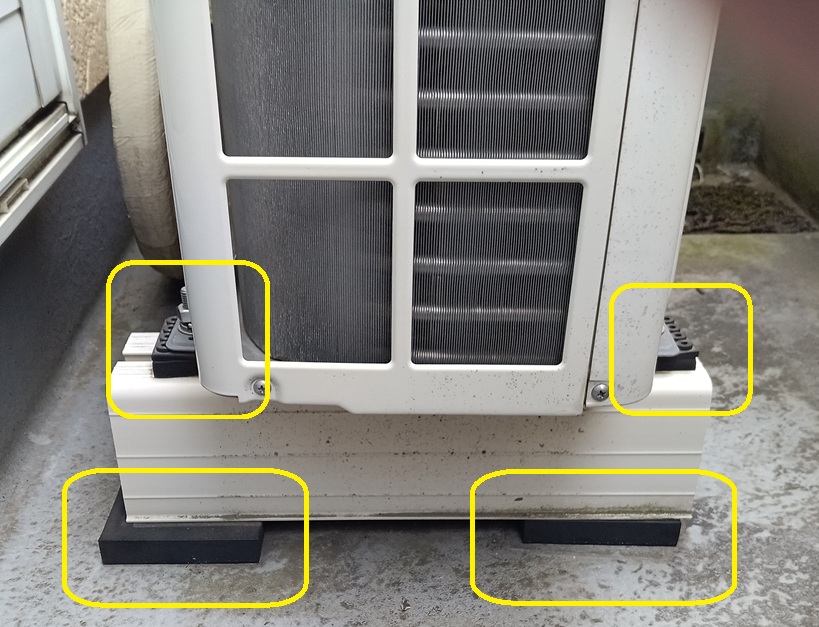
A chloroprene rubber sheet is attached to the area outlined in yellow.
Conclusion
We have covered topics such as how to choose an air conditioner in Japan. Weren’t there some points that you surprisingly didn’t know about?
We are about to face a hot summer, and an air conditioner is a must-have item. That’s why buying it wisely is important. Please be careful with how you choose and how you buy, and select the best model that suits you perfectly.