Discover three iconic tea bowls used in the Japanese tea ceremony — each offering a unique glimpse into Japan’s cultural soul.
If you’re a fan of traditional craftsmanship or fascinated by Japanese aesthetics, this is a must-read.
Summary
- In Japanese aesthetics, there is the concept of wabi-sabi.
- A tea bowl used in the tea ceremony is a crafted work of art; it is not made solely for beauty or practicality.
- Among the tea bowls particularly favored in the tea ceremony are those of Raku ware, Hagi ware, and Karatsu ware.
Characters
・Mike: A 12-year-old American boy interested in Japanese culture.
・John: Mike’s father, who frequently visits Japan for work.
・Kelly: Mike’s mother, who is a skilled cook.
・Nobu: A Japanese international student.
Key Insights Into Japanese Tea Ceremony Bowls
I want you to understand the beauty and meaning behind the tea bowls used in the Japanese tea ceremony.
However, it can be difficult to explain these cultural nuances with facts alone, so I’ll introduce them through a story—almost like a little home drama.
Prologue
Japan has many ancient cultures, and “Sado” (tea ceremony) is one of them. Since it is said to have started around the Sengoku period (Warring States period), it can be said to have a history of about 600 years.
While etiquette and manners for dining exist all over the world, I believe it is rare to find an art form that incorporates not just simple manners, but also utensils and space.
Now, what I would like to focus on here is the “Chawan” (tea bowl) used to make tea.
These tea bowls are also not mere tableware. They exude the ancient aesthetic sense of the Japanese people. While this aesthetic is important, the process of creating such tea ceremony bowls is also fascinating. Some people may know of the “finished tea bowl,” but very few know it “from the point of creation”.
So, here we look at the tea bowls used in tea ceremony. How do they appear to John, an American?
Discoveriing the Charm of Pottery
Points:
- Tea bowls used in the tea ceremony embody the artistic appeal of pottery.
- Japanese aesthetics include the concept of wabi-sabi.
John: “Hmm, tea ceremony bowls really go beyond being mere tableware.”
Kelly: “Oh, what are you looking at?”
John: “You know about Japanese ‘Sado,’ right? I was researching the bowls used in it.”
Kelly: “Aren’t tea bowls just ordinary dishes?”
John: “No, it seems that’s not quite the case. In the aesthetic sense of ancient Japan, there was the concept of ‘Wabi-Sabi’. Instead of designing flashily, they intentionally made things plain and simple.”
Kelly: “I see. There was also a sensibility that emphasized ‘Shibumi’ (refined sobriety), wasn’t there?”
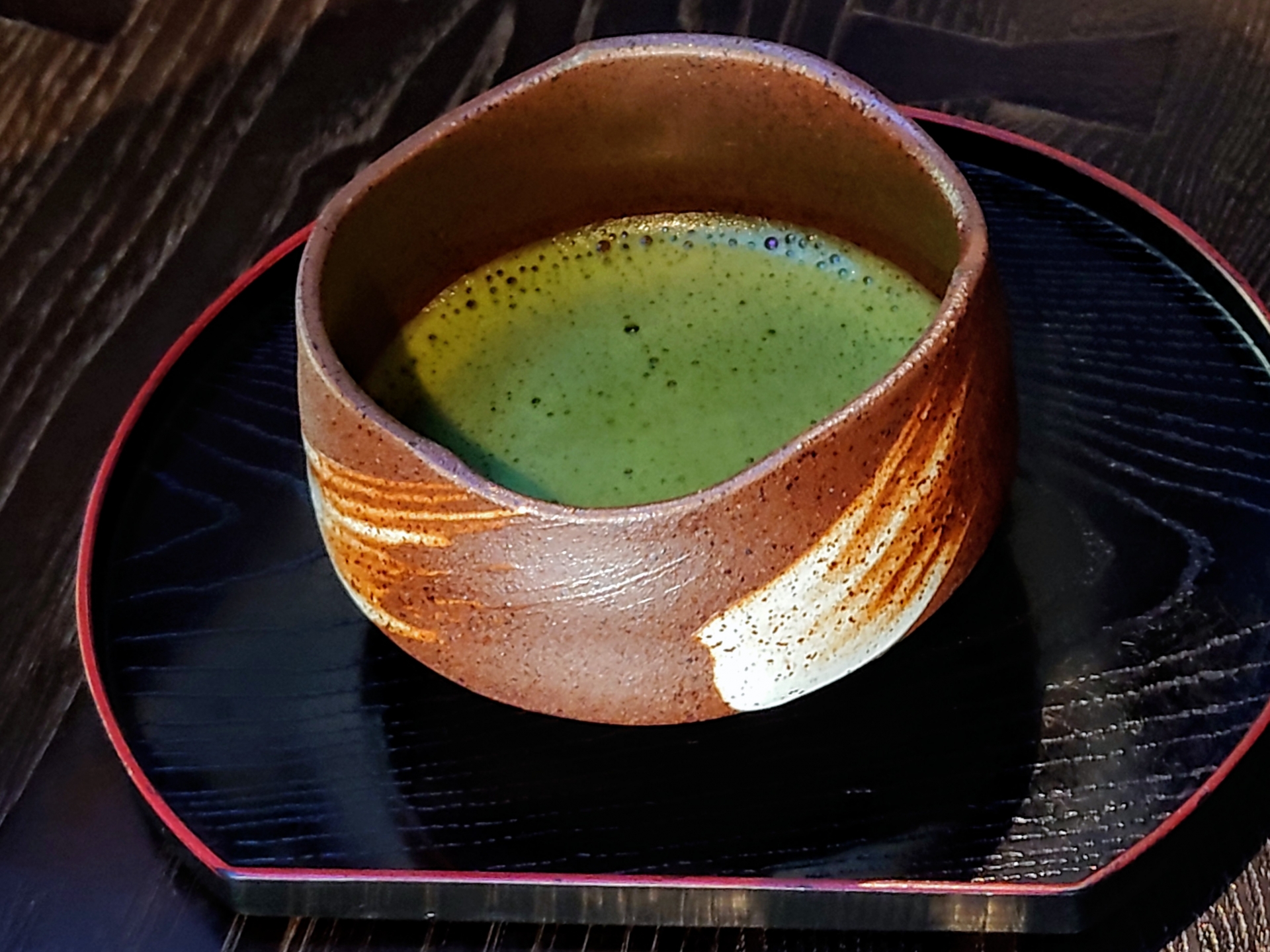
John: “Exactly. This tea bowl, for example, looks like it truly brings out that ‘Shibumi’. For instance, there are red tea bowls, but it’s not a redness painted with lacquer; it’s a redness created by firing the clay. It’s completely different from the coffee sets used by British aristocrats.”
Kelly: “I see. A comparison with the British upper class… I see, even though both are ancient cultures, their directions are completely different.”
John: “That’s right.”
A tea bowl used in the tea ceremony
Nobu: “Hello.”
John: “Oh, Nobu. Hello.”
Kelly: “You’ve come at a good time. There’s something I want you to tell us about—about Japanese tea.”
John: “Actually, it’s about the tea bowls used in the tea ceremony.”
Nobu: “Tea bowls, I see. You’ve found an interesting part of our culture.”
John: “Yes. I feel a depth that I’ve never experienced before, not just simple beauty.”
Nobu: “Certainly, the sensibility of ‘Wabi-Sabi’ could be said to be unique to the Japanese. People from abroad might be surprised by this different aesthetic.”
Kelly: “That’s it. That aesthetic is so interesting.”
Nobu: “By the way, the interest of a tea bowl isn’t just about ‘beauty’ or ‘usability.'”
Kelly: “What do you mean by that?”
Nobu: “How do you think this tea bowl is made?”
Kelly: “Isn’t it made in a factory? If it’s a Japanese factory, they’d make it easily, wouldn’t they?”
Nobu: “No, this is a craft. It is not made in a factory. Artisans create them by hand in their studios.”
Kelly: “That makes it even more amazing.”
Vessels Favored in Tea Ceremony
Point:
The appeal of tea ceremony ceramics is determined by the reactions that occur inside the kiln.
Nobu: “Let me introduce a bit about how these tea bowls are made. Modern pottery is made by shaping clay and firing it in a kiln. That hasn’t changed since ancient times. However, in the past, there was no machine control like we have now, so the artisans did everything themselves.”
Kelly: “What are some of the major changes?”
Nobu: “Probably the kiln.”
John: “The kiln. That makes sense. Nowadays, there are probably electric kilns and such.”
Nobu: “That’s right. Today’s kilns can be electric, but in the past, there was no electricity. They fired them in kilns using firewood.”
John: “I see, that would be the case.”
Nobu: “But there is a charm that comes specifically from using a wood-fired kiln.”
John: “What is that charm?”
Nobu: “Causality—or rather, ‘chance’ (coincidence).”
John: “Chance??? Was that beauty created by accident?”
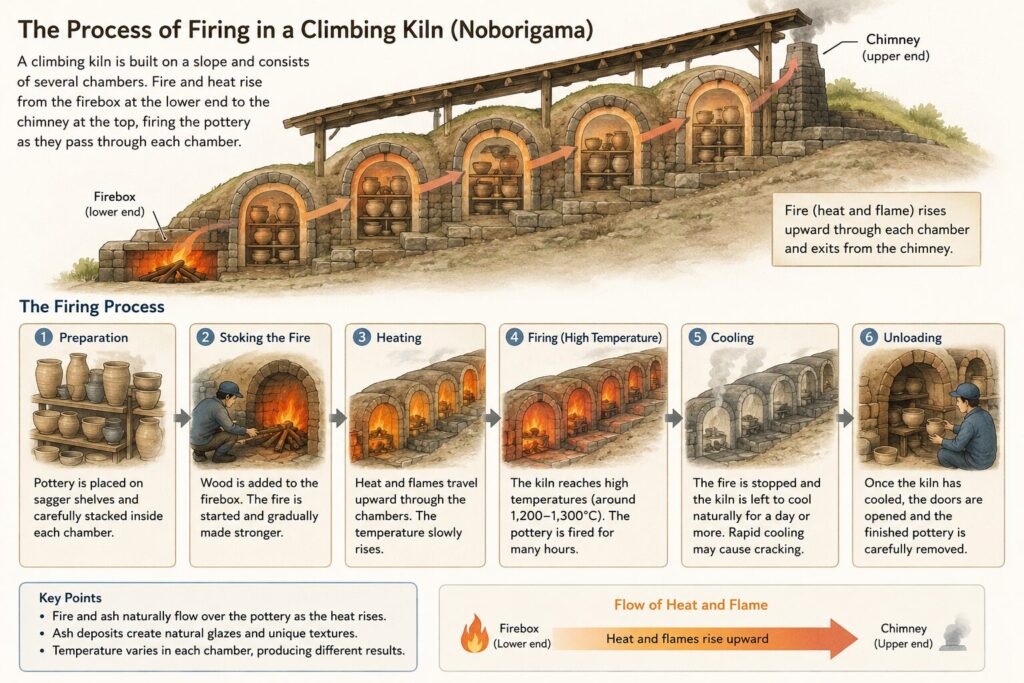
Nobu: “Not all of it, but the gloss and colors are often due to chance. First, when you burn firewood, ash and smoke will cover the piece.”
John: “Well, that’s natural. If you burn wood, you get smoke and ash.”
Nobu: “Then, what kind of reaction do you think that smoke and ash cause on the tea bowl?”
John: “Are we talking about a chemical reaction? …Hmm, doesn’t the smoke just escape through the chimney and that’s it?”
Nobu: “Certainly some escapes, but there are parts where it reacts with the glaze to create unique colors. Also, depending on the oxygen concentration inside the kiln, oxidation occurs in some parts and reduction occurs in others. Furthermore, the temperature in the kiln isn’t necessarily the same everywhere; it differs depending on the placement.”
John: “So you’re saying that the smoke and ash react with the glaze in various ways, and because the conditions inside the kiln differ, the outcome changes depending on where the bowl is placed?”
Nobu: “That’s exactly right. That’s what makes it interesting.”
John: “I see. That really is interesting.”
Tea bowls, there is a phrase.
Point:
For tea ceremony tea bowls, there is a saying: “Ichi-Raku, Ni-Hagi, San-Karatsu.”
Kelly: “Let’s put aside the difficult technicalities—can you tell us something more practical?”
Nobu: “Ah, my apologies.”
Kelly: “So, my question is, what kind of tea bowls are favored in the tea ceremony?”
Nobu: “Preferences vary from person to person, but in the tea ceremony, there is a phrase: ‘Ichi-Raku, Ni-Hagi, San-Karatsu’ (First Raku, Second Hagi, Third Karatsu). This is the order of tea bowls traditionally favored by tea ceremony enthusiasts. I think this is the best order to introduce the charm of tea bowls.”
Kelly: “Then please tell us in that order.”
Raku-yaki
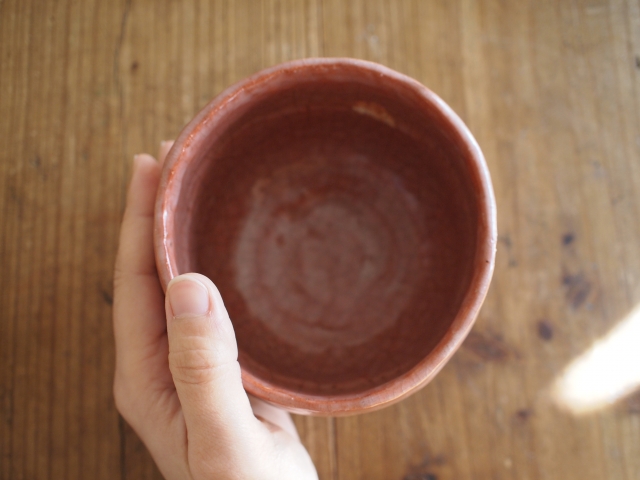
Nobu: “First is the ‘Raku’ of ‘Ichi-Raku.’ That is, ‘Raku-yaki’. It is made in Kyoto and is said to have started under the guidance of Sen no Rikyu. Its characteristic is that it is made by hand without using a potter’s wheel; the shape lacks sharpness and instead has a rugged atmosphere.”
Kelly: “This tea bowl has a distorted shape.”
Nobu: “Yes. That distortion and the changes in color are its charm.”
Kelly: “Oh, I see.”
Nobu: “By the way—and this is a common misunderstanding—many people think it’s called ‘Raku-yaki’ because it can be fired easily (‘raku’ can mean easy). But that’s not it. It is apparently called Raku-yaki because it is made by the ‘Raku family.'”
Hagi-yaki
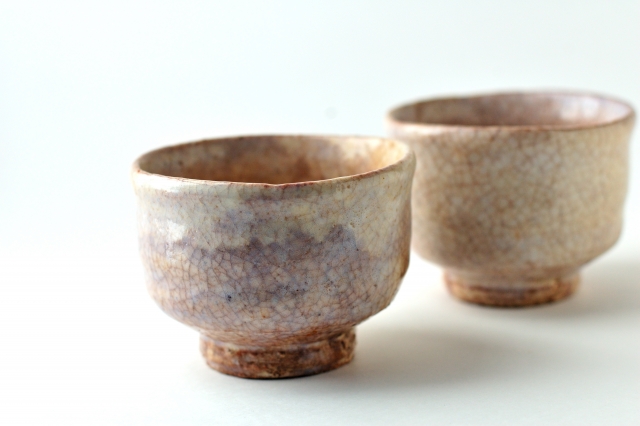
Nobu: “Next is Hagi-yaki. This is made in a city called ‘Hagi’ in Yamaguchi Prefecture. Hagi-yaki is characterized by its glaze. The glaze is a glassy layer on the surface of the pottery, and in the case of Hagi-yaki, there are fine cracks in this glassy part. Over many years of use, tea seeps into those cracks, creating a unique character (vibe).”
Kelly: “Even if you call it a unique character, it’s not a flashy kind of beauty, right?”
Nobu: “That’s right. You could call it ‘Shibumi’ itself.”
Karatsu-yaki
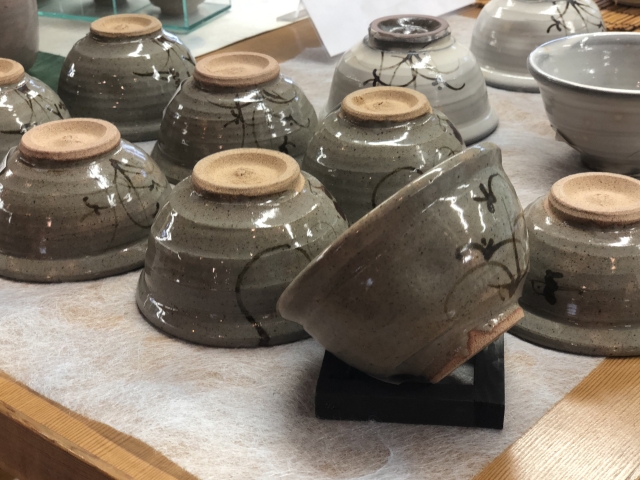
Nobu: “Karatsu-yaki is pottery made mainly in the city of Karatsu in Saga Prefecture. Its feature is that it is fired all at once at high temperatures. It has a rustic and unique ‘Shibumi.'”
John: “I see, ‘Shibumi’ again. Perhaps that’s a characteristic of Japanese crafts.”
Nobu: “By the way, it is also said that Karatsu-yaki was influenced by the continent.”
John: “The continent?”
Nobu: “China and Korea. They are geographically close.”
John: “I see.”
The Kiln
Nobu: “When looking at pottery, I really want you to see ‘where it is made’. There are places where you can experience making it on a potter’s wheel, so please check it out if you have the chance.”
John: “That sounds interesting too.”
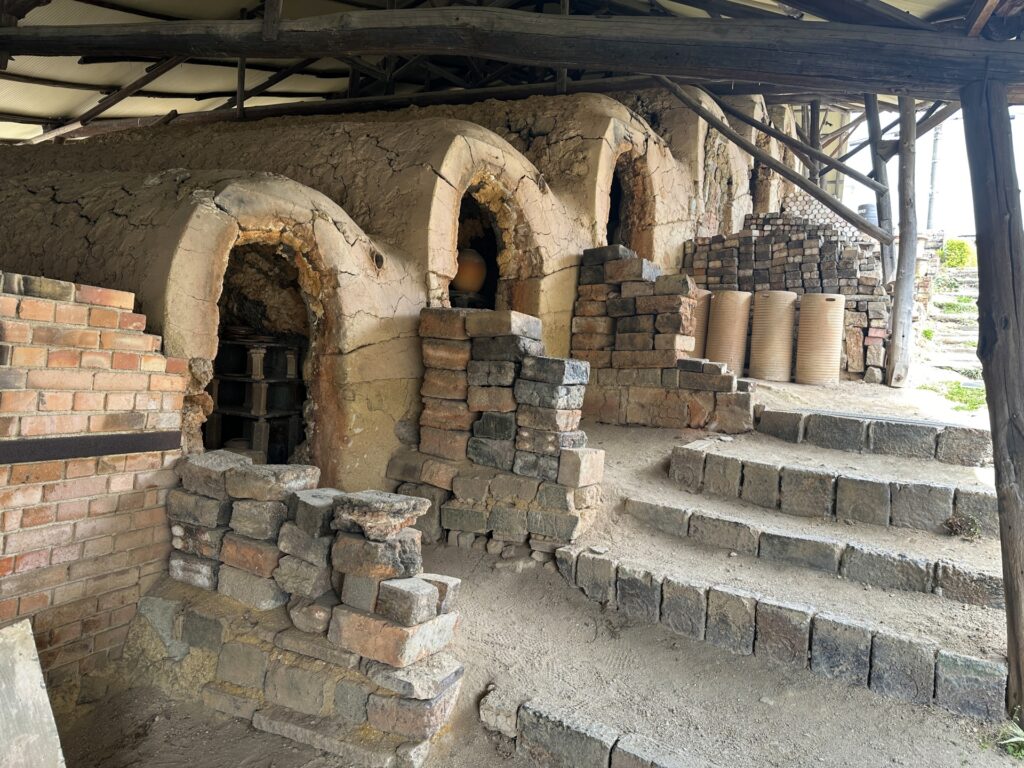
Nobu: “But I also want you to see the kilns. In particular, the ‘Noborigama’ (climbing kiln), which utilizes a slope, is a masterpiece. In the structure of the kiln, built by calculating the movement of smoke and ash, you might see the skills of ancient artisans.”
The Journey
John: “Nobu, thank you. It was truly interesting. It’s a culture and aesthetic I didn’t know about. I lost track of time listening to you.”
Nobu: “I’m glad to hear that… Ah, come to think of it…”
John: “Come to think of what?”
Nobu: “These three locations are surprisingly close to each other. If you take a little extra time, you might be able to visit all three.”
John: “How?”
Nobu: “First, you go from Tokyo to Kyoto. You can take the Shinkansen (bullet train) for that. After seeing Raku-yaki in Kyoto, you take the Shinkansen toward Hagi. You can see Hagi-yaki there and stay overnight. Finally, you head to Kyushu to visit the city of Karatsu.”
John: “I see. Could I do it in about a week?”
Nobu: “Probably, that should be enough. But…”
John: “But…?”
Nobu: “Well, near Karatsu, there are cities famous for pottery like Arita and Imari. Also, between Kyoto and Yamaguchi, there is Okayama Prefecture, famous for Bizen-yaki, and if you extend your trip to Nagasaki, you can enjoy glass crafts…”
John: “Hey, hey, I won’t have enough vacation time no matter how much I have!”
END
From my personal experience
Japanese tea bowls (chawan) are, of course, functional tools, but they are also profoundly significant as works of art. Every piece is captivating, from the forms shaped by a craftsman’s hands to the unpredictable tones and textures created by the kiln. I vividly remember how those colors, in particular, completely captured my heart.
Because of this, I remember wanting to purchase some for myself. Even though I don’t practice the tea ceremony, I wanted to collect them purely as exquisite examples of Japanese craft.
However, whenever I found a bowl that truly spoke to me, the price was always 30,000 yen or more—well beyond my reach at the time. It was quite a disappointment.
Interestingly, many of these bowls develop a deeper, more refined character (known as shibumi) the more they are used. Since it was about 30 years ago that I first thought of buying one, I imagine that if I had made the purchase and used it all this time, it would have transformed into a truly magnificent, seasoned vessel by now.
Conclusion
We have discussed the tea bowls used in the tea ceremony. Many of you may have noticed the Japanese aesthetic sense and the techniques passed down from ancient times that lie behind the tea bowl.
Some of you may have even felt hundreds of years of time within a single bowl. At any rate, it is best to hold a tea bowl in your hands and see it for yourself.
When you come to Japan, why not take a leisurely look at tea bowls and enjoy some delicious matcha and Japanese sweets? You might see a new side of Japan.