Both Japanese ramen and udon noodles are made from wheat flour, yet they are entirely different beasts. So, what exactly sets them apart? In this article, we’ll explore their unique differences through a storytelling lens.
Summary
The main difference between ramen and udon noodles is the use of kansui (alkaline water). Ramen contains kansui, while udon does not.
Characters
Mike: A 12-year-old American boy interested in Japanese culture.
John: Mike’s father, who frequently visits Japan for work.
Kelly: Mike’s mother, who is a skilled cook.
Nobu: A Japanese international student.
Prologue
One day, Mike found himself deep in a conversation about ramen with his friends. It started simply—discussing the differences between Miso, Salt, and Shoyu (soy sauce) bases—but the talk heated up and quickly turned “geeky.” Eventually, the topic shifted to the noodles themselves. Since neither Mike nor his friends had ever paid much attention to the specifics of noodle-making, the conversation became a game of guesswork. They left it at, “Well, ramen noodles are made of wheat, right?” and called it a day.
Meanwhile, Kelly and John were busy discussing another Japanese staple: Udon. When Mike returned home, he overheard them and decided to jump in, bringing his questions about ramen noodles to the table.
World’s Noodle Culture
John: “The world’s noodle culture is full of fascinating mysteries. You’ve got Asia—Japan and China, of course—but then you have Italy on the complete opposite side of the globe where noodle culture also flourished. Is there a connection? Or did they evolve independently? And if the idea was passed along, who was the messenger? It’s a real head-scratcher.”
Mike: “It is strange. To have such similar cultures on opposite sides of the planet.”
John: “Exactly. And if there is a connection, you run into the ultimate question: ‘Who made them first?'”
Mike: “I guess it would have to be someone with the means to travel long distances.”
John: “Right. That’s why people often think of Marco Polo’s era. I’ve always wondered if the culture was transmitted around that time.”
Mike: “But what about Genghis Khan? He led his cavalry from China all the way into Europe. I’ve heard a theory that the ‘bento’ they carried was actually Yakisoba.”
John: “I don’t know about the Yakisoba part, but the fact that the probability isn’t zero is what makes it fun.”
Mike: “True. But if we’re going down that road, shouldn’t we ask, ‘Who was the first to actually make noodles out of wheat?'”
John: “Good point. Wheat noodles… We have those in Japan, too.”
The ingredient “Kansui” (alkaline water)
Kelly: “Oh, what are you two talking about?”
John: “Just the world’s noodle culture. Where the first noodles came from, who spread them—that kind of thing.”
Kelly: “That sounds fascinating. I love it when food culture and world history overlap.”
John: “Exactly. We’re talking Italy, China, Japan… the whole world. And then…”
Kelly: “And then what?”
John: “Well, it gets overwhelming if we think too big. But even if we just look at Japan, there are so many different types of noodles. I was wondering why that is.”
Kelly: “True. And then there’s the question of the ingredients.”
John: “Exactly.”
(Nobu enters)
Nobu: “Hello there.”
John: “Oh, Nobu! Perfect timing.”
Kelly: “We wanted to ask you something. Japan has so many noodles—Ramen, Udon, Soba… Soba is made from buckwheat, but Ramen and Udon are both made from wheat, right? Setting Soba aside, I don’t understand why Ramen and Udon are so incredibly different if they use the same grain.”
Nobu: “Ah, Ramen and Udon. The difference really comes down to whether or not they contain ‘Kansui‘ (alkaline water).”
Kelly: “Kansui?”
Nobu: “Simply put, it’s a mineral solution. To be technical, it’s an alkaline food additive containing things like potassium carbonate and sodium carbonate.”
Kelly: “Wait, wait… I was never very good at chemistry.”
Nobu: “My apologies! Let me break it down into simpler terms.”
About Ramen Noodles
Point:
Ramen noodles get their elasticity by adding “kansui” (alkaline water).
Nobu: “The bottom line is that Kansui is a ‘strongly alkaline food additive.'”
Kelly: “Wait, an additive?”
Nobu: “Yes. But in Japan, it’s strictly regulated as a food product, so it’s perfectly safe to eat.”
Kelly: “Phew, that’s a relief.”
Nobu: “Now, think about wheat flour. It’s usually white, right? Even if you knead it with water, the color doesn’t change—like pizza dough.”
Kelly: “Now that you mention it, you’re right.”
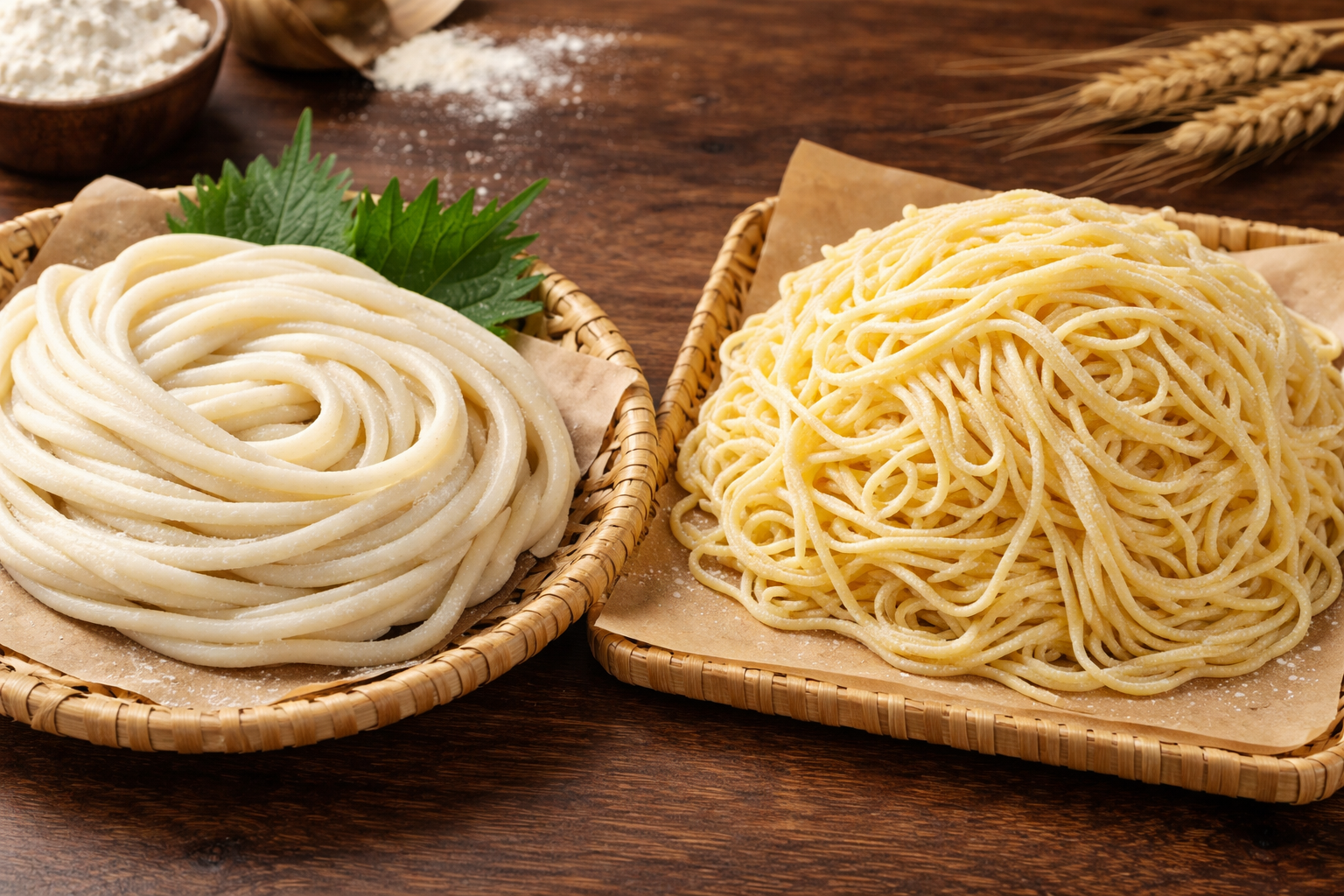
Nobu: “But Chinese-style ramen noodles are different. They look yellow. When you use Kansui, it causes a chemical reaction with the wheat that turns it yellow.”
Kelly: “But if it just changes the color, it seems a bit unnecessary.”
Nobu: “If it were just for the color, we might not need it. But Kansui serves a much bigger purpose.”
Kelly: “How so?”
Nobu: “Beyond the yellow hue, it gives the noodles their unique elasticity and ‘chew’ (koshi). It’s also vital for that distinct ramen aroma.”
Kelly: “I see… so it’s all about the chemical reaction.”
About Udon
Point:
Udon noodles get their elasticity without kansui, by kneading the dough with strong physical pressure.
Kelly: “But wait a minute. We have Udon in Japan, too. Those noodles are white. They aren’t yellow like ramen.”
Nobu: “That’s right. Udon is white. Since it’s made from wheat, it’s natural for it to stay white.”
Kelly: “That’s what I don’t get! Udon is also elastic and has a great ‘chew.’ How do they get that texture without the chemical reaction?”
Nobu: “Because they tread on it with their feet.”
Kelly: “Excuse me?!”
Nobu: “They knead the dough by stepping on it to create elasticity. Wheat contains a protein called gluten, which provides structure. In Ramen, Kansui acts on the gluten to create that bounce. But in Udon…”
Kelly: “What about Udon?”
Nobu: “Like I said, Udon is stepped on. This is a method that uses the physical properties of gluten. Gluten becomes stronger and more elastic when physical force is applied. So, we use our feet to knead it.”
Kelly: “Couldn’t you just use your hands?”
Nobu: “Stepping is just much more efficient. For example, Kelly, if we assume you weigh… say, 60kg. Could you knead dough with 60kg of force using just your hands?”
Kelly: “I… I don’t think so.”
Nobu: “Exactly. Human arm strength has its limits. Even if you lean your whole body weight into it, it’s inefficient. By stepping on it, you can apply your full weight directly. If you used your hands, you might only apply 15kg of force, but with your feet, you’re hitting it with the full 60kg. It’s very effective… well, although nowadays machines do the kneading with similar force.”
Kelly: “Nobu… can I have a word?”
Nobu: “Sure, what is it?”
Kelly: “Isn’t it a bit rude to talk about a lady’s weight so casually?”
Nobu: “Oh… Hahaha! You’re right. My mistake! Sorry about that!”
END
From my personal experience
In Japan, there are specialty shops for both ramen and udon, and if you look closely, you’ll often see the noodles right there inside the shop. Some udon shops even make their noodles right at the storefront, allowing you to watch the entire process. Watching them craft udon is truly impressive.
From what I’ve seen at these shops, udon is made by kneading wheat flour with water, then stretching and cutting it. It requires genuine craftsmanship that is hard for an ordinary person to replicate. Udon made this way has a great “koshi” (a firm, chewy texture), making it incredibly delicious.
While you can buy udon at supermarkets, those noodles usually don’t have that same strong, chewy texture. So, if you come to Japan to try udon, I highly recommend going to a specialty shop.
By the way, my personal favorite is a place called “Marugame Seimen.” Although it’s a chain, they make their noodles fresh at every location, so you can enjoy delicious, freshly made udon.
Here is the URL for the shop: https://jp.marugame.com/
Conclusion
In this post, we explored the differences between Ramen and Udon noodles. Hopefully, this answers the question for anyone wondering, “Why are they so different when they’re both made from wheat?”
It’s interesting to think that Kansui is a food additive that has been used for centuries. While we might call it “ancient wisdom” today, there must have been a “first person” to ever use it. Perhaps they were creeped out at first by the water that turned wheat yellow!
Also, it seems that if Kansui is too concentrated, it can cause an upset stomach. I can’t help but wonder if that first person had to deal with a stomach ache while testing it out. The “romance” of history truly is endless, isn’t it?
In any case, Japan has many more fascinating food cultures to explore. We can’t cover them all here, so let’s save those for next time!