Japan’s railways are considered among the best in the world, and many people abroad are fans of Japan’s trains.
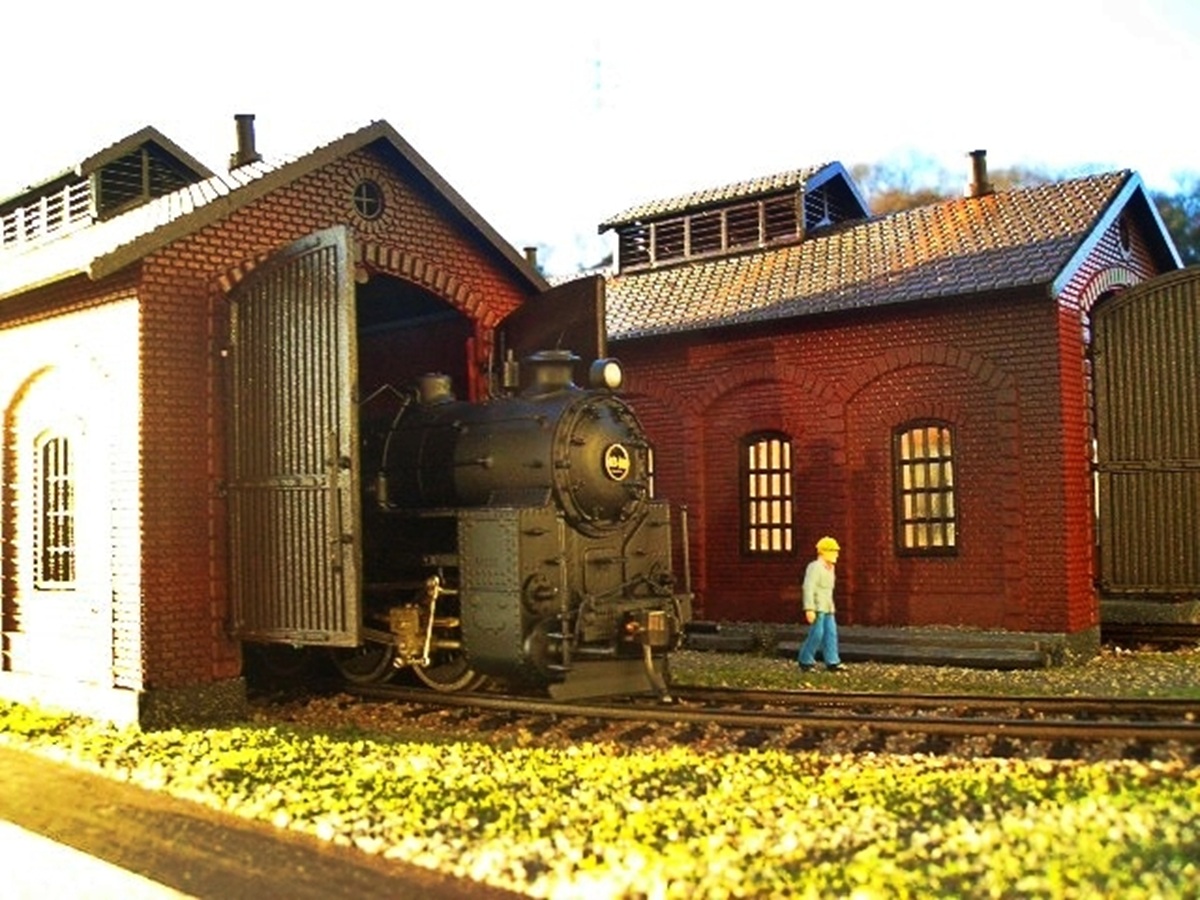
One of the most enjoyable ways to experience Japanese railway culture is through railway models. In Japan, model trains are a popular hobby with dedicated enthusiasts, and many railway fans enjoy them as well.
In this article, we introduce Japanese railway models through a story-style explanation for readers who want to explore and appreciate Japan’s railways even more.
Summary:
N gauge at 1/150 is common in Japan.
Characters
- Mike: A 12-year-old American boy interested in Japan.
- John: Mike’s father. A businessman who occasionally travels to Japan.
- Kelly: Mike’s mother. A skilled cook.
- Nobu: A Japanese international student.
Prologue
The railways in Japan are highly developed. With just a ticket, it is possible to travel from Hokkaido in the north to Kyushu in the south. Furthermore, Japan has the Shinkansen. The Shinkansen can be described as “trains of representative Japanese technology” that balance both comfort and speed.
While there are many railway enthusiasts in Japan, there is one particular culture I want people overseas to know about. That is Japanese “model trains” (railway models).
About Japanese Model Trains
Mike: “Hey, I heard Japanese trains run at an amazing level. They say they run perfectly on time. And in big cities, trains come so frequently that you don’t even need to wait.”
John: “That’s right. While delays often happen in other countries, they almost never occur in Japan. If there is a delay, an announcement is made at the station. They must be extremely strict about time.”
Mike: “Plus, many Japanese trains look cool. The Shinkansen is sharp and really cool.”
John: “Indeed. The Shinkansen is popular among Japanese children, too. Some kids are even envious when someone says, ‘I came here on the Shinkansen’.”
Mike: “Then there must be many railway-related toys. Like things that make you feel like a driver while operating them.”
John: “There certainly are. Battery-powered toys for children are among the top most popular, alongside toy cars.”
Mike: “Wow, if it’s interesting, I’d like to see it.”
John: “Hahaha, Mike, you’ve graduated from those kinds of toys. Those are for kindergarteners.”
Mike: “You’re right. But that’s boring.”
John: “Actually, there is something suited for you.”
Mike: “What? A railway toy for me? “
John: “It’s not a toy. It’s a model train. Japanese model trains are exquisitely made and amazing.”
About Western Model Trains
Nobu: “Hello.”
Mike: “Hello. You came at the right time. We were talking about Japanese model trains and wanted to learn more.”
Nobu: “Model trains? I’m not very knowledgeable, but I can introduce them if that’s alright.”
John: “First, let’s talk about size. Surprisingly, many people in America have model trains as a hobby, but most use HO gauge. I believe the track width is 16.5mm and the scale is about 1/87. Because they were exquisitely made, they became a hit with railway lovers.”
Nobu: “Running at 1/87 scale? I see, that must look cool.”
John: “Yes. Some people even prepare a dedicated room for their model trains. They enjoy running tracks all over the room.”
Nobu: “They build layouts too, right? ”
John: “Exactly. They lay rails across the whole room and assemble a layout there. It’s truly spectacular. …However, some people are troubled by this.”
Mike: “Troubled people??? ”
John: “Yes. If the family doesn’t understand the hobby, it looks like the models are occupying the room.”
Mike: “I see. That might be true.”
N gauge at 1/150 is common in Japan
John: “Now it’s Nobu’s turn. Tell us about Japanese model trains.”
Nobu: “Sure. Regarding the scale, I think N gauge at 1/150 is common in Japan.”
John: “What? 1/150? Can they make something that detailed? ”
Nobu: “Yes, N gauge is popular in Japan. The track width is 9mm, I believe. Anyway, they are made very minutely.”
Mike: “Hey, how detailed is 1/150? ”
Nobu: “For example, it’s harder to write characters in a 5mm square than in a 1cm square, right? ”
Mike: “Of course, the smaller it is, the harder it is.”
Nobu: “Exactly. N gauge is about half the size of HO gauge. If you were writing characters, it would be like writing in 1/4 of the area. It means Japanese people are doing that detailed work.”
Mike: “Amazing.”
Nobu: “And Japanese model trains have a wide variety. There are new models like the Shinkansen, but also steam locomotives. Also, functions. I think foreign models have this too, but sometimes the lights turn on.”
Mike: “The lights too? ”
Nobu: “It’s realistic and cool when it comes out of a tunnel with lights on. Particular people care that much.”
Mike: “I see, that sounds cool.”
Nobu: “Then there is self-building. While handmade scenery for layouts is standard, some people even build the train cars themselves.”
John: “They build the cars too? ”
Nobu: “Yes, some people do. Perhaps they aren’t satisfied with commercially available models.”
John: “That’s impressive.”
The Background of Japanese Railways
John: “But there is one thing I find mysterious.”
Nobu: “What is it? ”
John: “I don’t understand why N gauge became so widespread in Japan. I think there must have been a reason for making them so minute.”
Nobu: “I suspect… the housing situation is the background.”
John: “Housing situation? ”
Nobu: “As you may know, the housing situation in Japan is not very good. Therefore, I think it is difficult to secure enough space just to lay rails.”
John: “So that’s why it’s N gauge. Certainly, if it’s small, it requires less space.”
Nobu: “Yes. Especially in densely populated areas like Tokyo, rents are skyrocketing. It might be hard even to find a large room. So, N gauge was an inevitability.”
John: “I see, that makes sense.”
How to Enjoy Model Trains
John: “By the way, I understand model trains are great, but what kind of people in Japan have this as a hobby? In America, it feels like an ‘adult hobby’.”
Nobu: “I think it’s basically the same in Japan. It’s fundamentally an adult hobby. However, there are many children who love trains. …But since model trains are an expensive hobby, it might be easier for adults who have financial freedom to pursue it. Also, I think many children play video games.”
John: “That might be true.”
Nobu: “Also, it might be problematic for a child to occupy a large room. An adult might be able to create a ‘hobby room,’ but a child may not have that much free space.”
Mike: “I see.”
End
The State of Japanese Model Trains
How was it? We have introduced a little bit about the hobby of model trains in Japan. However, because some information couldn’t be included well in the story’s structure, I will provide a bit more information here.
Incidentally, it seems many people in their 40s enjoy model trains, but in recent years, the younger generation in their 20s is also enjoying them.
Market Related Information
According to a report from an economic research institute, two companies—Sekisui Kinzoku Co., Ltd. with the “KATO” brand and Tomytec Co., Ltd. with the “TOMIX” brand—hold a 75% market share in N gauge. Both are loved by many because they are successful and offer excellent expandability. Incidentally, there are also “doujin” (fan) circles for model trains. It appears these circles are where people enjoy building their own train cars.
Ways to Enjoy
Ways to enjoy model trains vary case by case. However, as mentioned before, because of the housing situation in Japan, the way individuals enjoy them differs. Therefore, categorizing hobbyists is difficult, but here are some representative ways of enjoying them.
Those who enjoy displaying
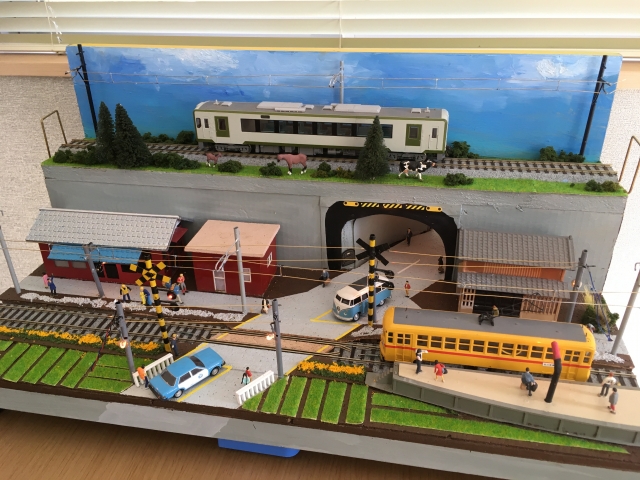
First are those who enjoy displaying their models. Display styles vary; some display single units, while others create small-scale layouts for display. Since N gauge models are small, the appeal is that they can be easily displayed even in narrow spaces.
Those who enjoy operating
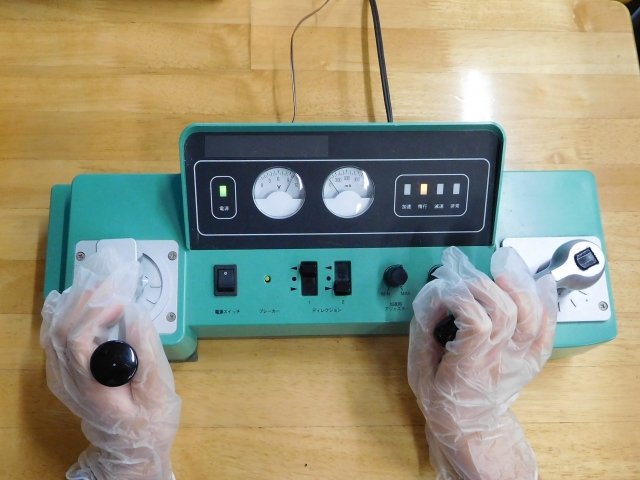
Next are those who enjoy driving/operating them. The way they enjoy operation also seems to vary. While most use manufacturers’ control devices, some people build their own power packs. It seems there are literally “geeky” hobbyists as well.
Those who enjoy building:
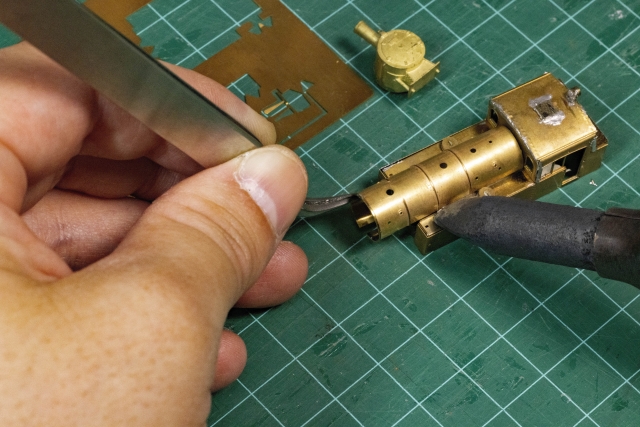
There are two types of builders. One is the person who enjoys building layouts, and the other is the person who enjoys building train cars. The appeal of layouts is being able to create your favorite scenery, but this also divides by personality. Some create urban scenes, while others seem to enjoy local scenery such as mountainous or rural areas.
Collectors
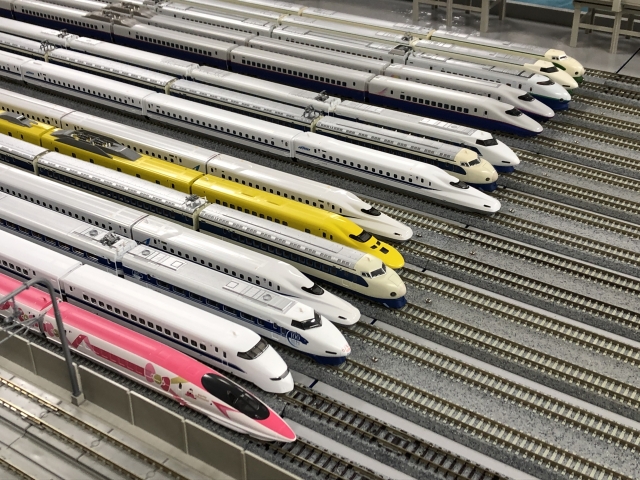
There are also collectors in the world of model trains. They may enjoy purchasing not only Japanese vehicles but also overseas vehicles. Prices range from inexpensive items costing a few thousand yen to expensive items exceeding 100,000 yen.
Video Recording
If you look at video posting sites, you will see people who film videos of their own layouts and upload them to the internet. Video creation is now something many people can enjoy. It must feel good to watch footage of trains rushing along to one’s favorite music.
From My Personal Experience
In the past, I was also deeply into model railroading and spent a lot of time researching how to build layouts. One of the biggest dilemmas I faced was deciding what kind of panel to build the layout on. Here, I would like to introduce two types of layout boards that I explored during my research.
For Small Layouts
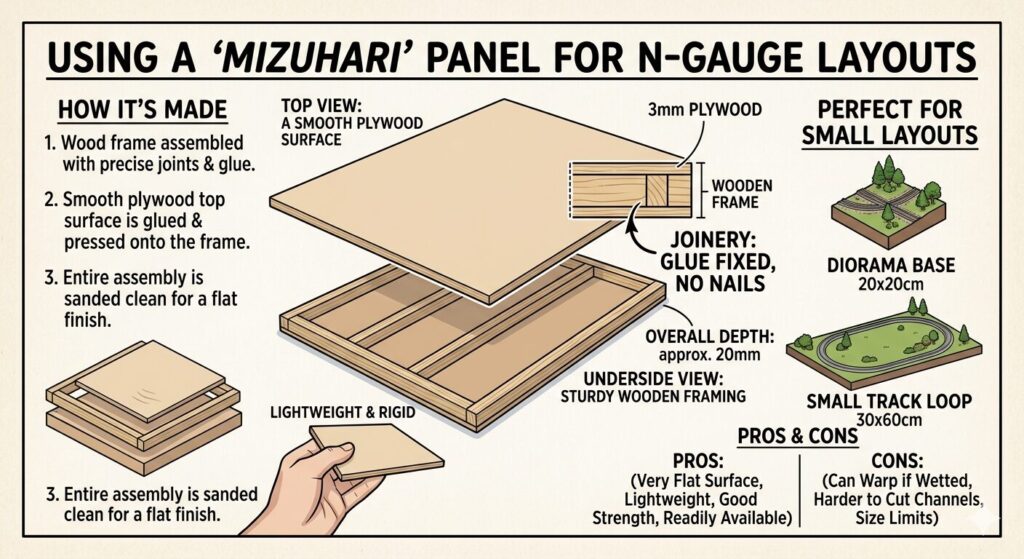
If you are looking to display a model or create a compact scene, I highly recommend using a “mizuhari” panel (a wooden stretching board typically used for watercolor painting). They come in a wide range of sizes, from small 20-centimeter squares up to large plywood sheets. So, you can use a small panel just for a quick display, or a larger one for a medium-sized layout.
These panels are sold at art supply stores, though you may want to check their inventory beforehand. Personally, I think they are perfect for creating a cozy, local scenery where a short train of about two cars comes to a stop.
For Large Layouts
For a large-scale layout, you should definitely build it using a plywood base. However, the key factors here are the thickness of the plywood and the framing. While thicker plywood provides solid stability, it also adds a lot of weight. To counter this, you can use framing materials underneath, which allows you to use thinner plywood while keeping the entire structure lightweight.
When securing the frames, I highly recommend using wood glue rather than nails or screws, as the heads of nails or screws can get in the way and ruin the flat finish. By the way, when you attempt to build a massive layout, you might find that you can’t reach the center of the board, making it very difficult to work on the scenery. As a result, the detailing there might end up a bit sloppy. To achieve a high-quality finish, it is crucial to keep the layout within your physical reach.
Conclusion
I have introduced a little bit about Japanese model trains. For those interested in Japanese railways, I believe this was interesting information. Especially for those who already have model trains as a hobby and were interested in Japanese culture, I hope you enjoyed it. Please enjoy Japanese model trains.
Incidentally, Japan has “four seasons”. For those who build layouts, I recommend “layouts of the four seasons”. Scenes of a hot summer day differ from deep snow scenes, and the season of autumn leaves is also different.
I think it would be good to enjoy Japan’s four seasons through model trains. However, enjoying all four seasons might require four rooms. I ask that you secure that space at your “own responsibility”. Please don’t say, “It’s the fault of this guy who told me about this interesting hobby!”.
Recommended Article
If you’re interested in traveling by train in Japan, this article is perfect for you. It introduces Japan’s unique ekiben (station bento) culture.
What Is Ekiben? A Guide to Japan’s Unique Train Bento