Without knowing how electricity works in Japan, you might run into unexpected trouble during your travels. To help you avoid any surprises, here is a quick guide to Japan’s power supply.
Summary
- Japan’s domestic power supply operates at 100 volts AC (Alternating Current).
- The frequency is 50 Hz in Eastern Japan (including Tokyo) and 60 Hz in Western Japan(including Osaka).
- The typical household electricity capacity ranges from 40 to 60 amps.
Characters
・Mike: A 12-year-old American boy interested in Japanese culture.
・John: Mike’s father, who frequently visits Japan for work.
・Kelly: Mike’s mother, who is a skilled cook.
・Nobu: A Japanese international student.
Prologue
For travelers or those planning to move to Japan, the electrical situation can be an unexpected pitfall. Japan’s domestic power supply is unique compared to other countries, and the differences go beyond just the shape of the plug. Understanding these quirks is essential for anyone planning a trip or a move to Japan.
Confusing in the Business Trip
John: “Man, my business trip to Japan last week was a total disaster, and I was there for a full seven days.”
Mike: “A whole week in Japan sounds great, though. What was your schedule like?”
John: “My hosts were thoughtful—they arranged for me to arrive on a weekend and fly back the following weekend so I could see the sights before starting work.”
Mike: “Nice! So you got to see Tokyo on your first day? What did you visit?”
John: “Well… I mostly saw the inside of an electronics store. I was shocked by how affordable things were, though. Japanese appliances have high-end lines, but there are plenty of budget-friendly options too.”
Mike: “Japanese tech is famous for its performance. But why did you spend your whole sightseeing day in an electronics store?”
John: “I had no choice. I got to the hotel, took a shower, and realized I couldn’t use my hairdryer. I brought a transformer because the outlets are different, but the hotel had a policy against using them. I had to go buy a Japanese hairdryer the next morning.”
Mike: “And?”
John: “Finding the store was a nightmare. The streets are packed with buildings, and I couldn’t find anyone who spoke English to give me directions. Even when I found the shop, the staff didn’t speak English either. By the time I got what I needed, my day off was over.”
Mike: “What a waste of a weekend!”
John: “Exactly. I’ve been to Japan before, but it was never this hard because the hotels usually provided everything. I guess picking a different hotel this time was my mistake.”
There’s a limit on the total amperage.
Point:
Since hotel rooms have a limited amperage capacity, you need to be careful when using high-power appliances like hair dryers to avoid tripping the breaker.
Kelly: “That sounds awful. But wait—does that mean people moving to Japan can’t bring their own appliances?”
John: “Pretty much. A cheap hairdryer is one thing, but if you’re living there, you need big appliances. If yours won’t work, you have to buy everything brand new in Japan.”
Kelly: “Can’t you just use a transformer?”
John: “Even if you have one, it’s tricky. Even if you step up the voltage, there’s a limit on the total amperage. If you plug in too many things, you’ll just trip the breaker. It’s not really practical for a whole household.”
The Grid
Points:
- Japan’s domestic power supply operates at 100 volts AC (Alternating Current).
- The frequency is 50 Hz in Eastern Japan (including Tokyo) and 60 Hz in Western Japan(including Osaka).
Nobu: “Hello, everyone!”
John: “Hey, Nobu. Perfect timing.”
Kelly: “Nobu, can you settle this? What’s the deal with Japanese electricity?”
Nobu: “Sure. In short: Japan uses 100V AC. The frequency is 50Hz in Eastern Japan (Tokyo) and 60Hz in Western Japan (Osaka).”
John: “That’s quite low, isn’t it?”
Nobu: “It is. The US is 120V, right?”
Mike: “Correct. 120V AC, and the frequency is 60Hz.”
John: “And in Europe, they go over 200V. It’s a huge difference.”
Nobu: “While lower voltage may reduce the chance of a severe electric shock, this does not mean that it is ‘safe.’ Electricity can still be dangerous.”
John: “I guess that’s a plus. But what about the capacity?”
Nobu: “Amperage depends on your contract. Modern homes usually have about 60 amps, but older apartments might only have 40.”
John: “See? That’s the problem. In the West, we can run the AC, the microwave, a kettle, and a hairdryer all at once. In Japan, if you do that, you’ll be sitting in the dark because the breaker will trip immediately.”
Nobu: “Sadly, you’re right. We all wish we had a bit more power to work with!”
Shapes of Outlets and Plugs
Mike: “By the way, are the shapes of outlets and plugs the same in Japan?”
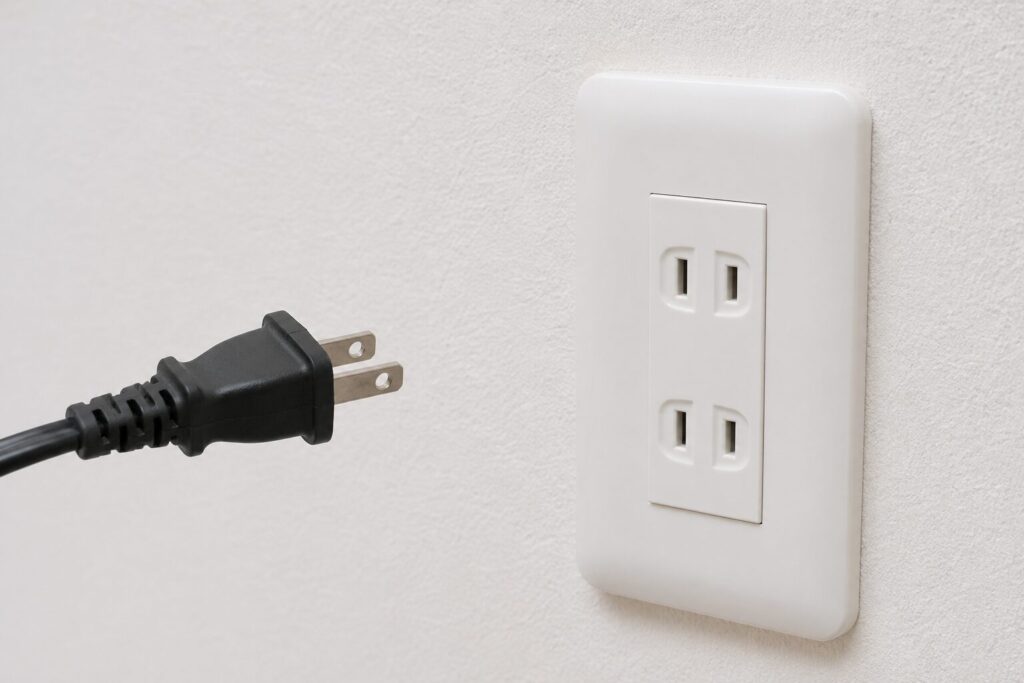
John: “It depends on where you’re from. For instance, they look the same as in the US, but they’re totally different from Europe. But here’s the catch: even if the plug fits perfectly, the voltage in Japan is often different—it’s 100V, which is among the lowest in the world. That’s why you might need a transformer.”
Mike: “I see.”
John: “For your reference, this is what Japanese outlets and plugs look like.”
Daily Life in Japan
Nobu: “Actually, many people in Japan struggle with these power limits, especially those who have recently bought new homes.”
John: “Why is that?”
Nobu: “It’s because of the rise of large, power-hungry appliances—especially in the kitchen.”
Kelly: “Tell us more about that.”
Nobu: “Kitchen appliances have multiplied. It used to be just a microwave, but now we have IH (induction) cooktops and dishwashers. They all consume a massive amount of power, which makes things difficult.”
John: “But don’t people know that before they buy them? You’d think they’d find a way to manage if they knew.”
Nobu: “The problem is that many people don’t realize the power constraints until it’s too late. For example, many apartments come with IH cooktops pre-installed, or people install dishwashers without considering the total electrical load.”
John: “So, they only discover the problem after they start living there.”
Nobu: “Exactly. It can be a real struggle. It’s hard to tell someone to ‘turn off the air conditioner’ just because you want to use the microwave and the IH cooktop at the same time!”
End
A Deeper Look at Japan’s Electricity
The electrical differences between Japan and the West are significant. Travelers often face inconveniences at hotels, and expats may find themselves frustrated by the “weaker” performance of Japanese appliances. For instance, a kettle in Japan takes longer to boil water compared to high-voltage European models.
While 200V lines are available in many homes for heavy-duty air conditioners, standard wall outlets are 100V, making high-voltage foreign devices unusable for everyday tasks. Understanding these basics is essential before arriving in Japan.
Which Appliances Consume the Most Power?
You might wonder how people manage with such low voltage. While Japanese appliances are highly energy-efficient, many still require significant power. Here are some common examples:
- Microwave Oven
- Power Consumption: 1,000–1,400W (10–14A)
- Microwaves are notorious for sudden power surges that can trip a breaker instantly. Be careful when using them alongside IH cooktops or kettles.
- Hairdryer
- Power Consumption: 1,200–1,500W (12–15A)
- These small devices draw a lot of current because they generate high heat. If multiple people are using them, it’s best to set house rules to avoid blackouts.
- Air Conditioner
- Power Consumption: 300–1,500W (3–15A)
- Consumption varies by season and the building’s insulation. When choosing an apartment, it’s important to ask about its energy efficiency.
- IH Cooking Heater (Induction Cooktop / Portable Models)
- Power Consumption: 1,000–1,400W (10–14A)
- Standard 100V portable models are designed to stay just under the 15A limit of a single outlet, but they still draw massive amounts of power. Using one at the same time as a microwave on the same circuit will almost certainly trip the breaker.
- Electric Kettle / Pot
- Power Consumption: 1,200–1,400W (12–14A)
- These heat water in a very short time, consuming a large amount of electricity instantaneously.
From my personal experience
I’ve had my fair share of mishaps at hotels by forgetting to check the number of available power outlets. There have been times when I simply couldn’t charge everything I needed during my stay.
Typical examples are rechargeable shavers and mobile phones. Even if you remember to bring your AC adapters, they are useless if there isn’t a vacant outlet to plug them into.
Of course, these days you can easily pick up a power strip at a 100-yen shop to solve the problem. However, you can’t always count on finding such a convenient store near your hotel. To be on the safe side, I think it’s a good idea to double-check the number of outlets when you make your reservation.
For reference, I measured the voltage and frequency of a power outlet in my home.
Because I live in Tokyo, the outlet was rated at 100 volts AC with a frequency of 50 hertz. To verify this, I used a digital multimeter and recorded the measurements myself.
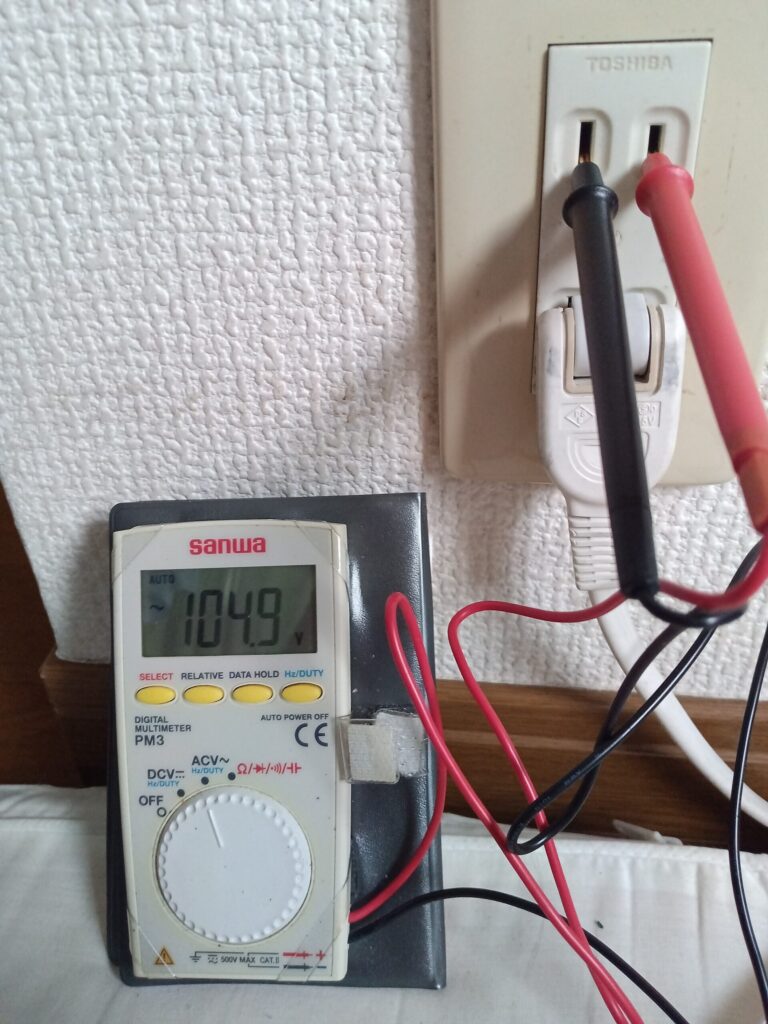
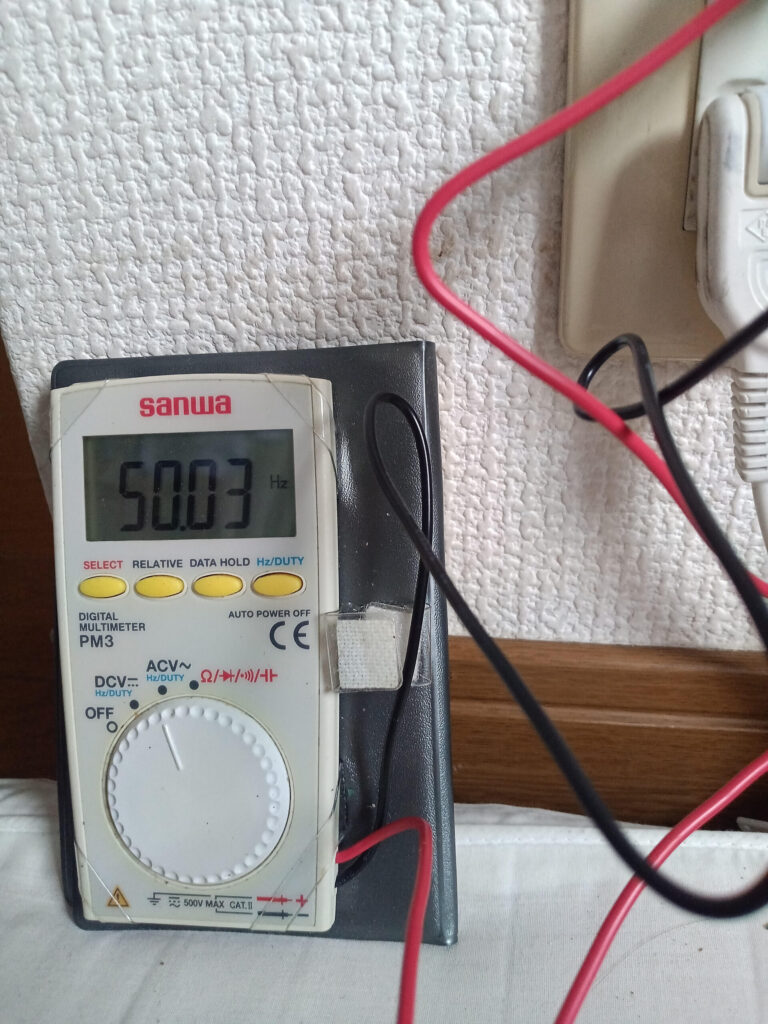
The measurements showed a voltage of 104.9 volts and a frequency of 50.03 hertz.
The voltage reading was slightly higher than the nominal 100 volts, but this is generally considered normal, as household voltage often fluctuates
Conclusion
Appliances are indispensable for modern life, so understanding the local electrical environment is vital. Bringing appliances from home only to find them unusable can be a major setback.
Also, keep in mind that electronics stores often ship from warehouses rather than carrying every item in-store.
Always confirm the delivery date when purchasing to ensure a smooth start to your life in Japan.