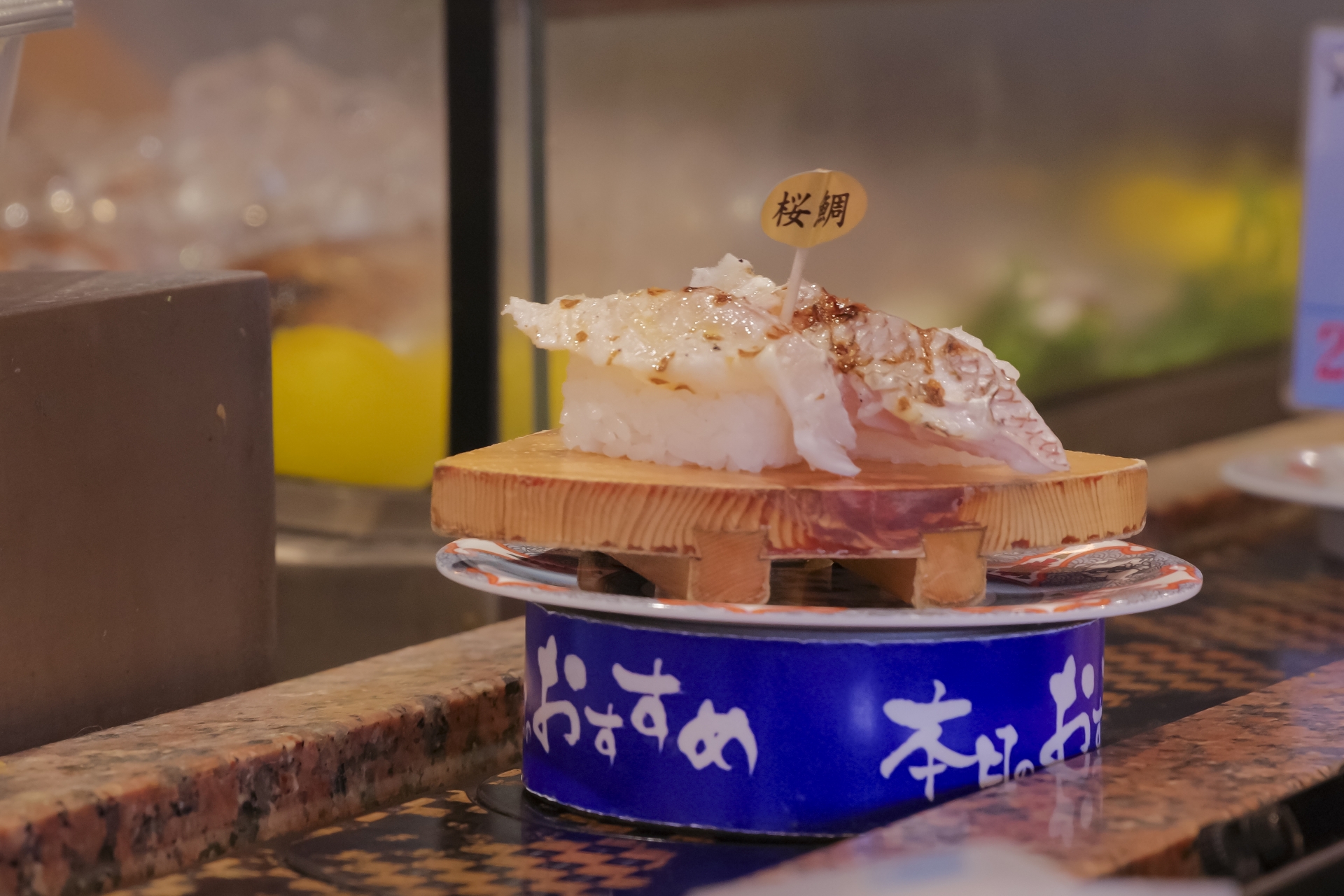
Do you know how much conveyor-belt sushi costs in Japan?
The prices are probably quite different from those at conveyor-belt sushi restaurants overseas.
So, how much does it actually cost?
Summary
- Low-End Price Range (Around 120 Yen)
- Mid-Range Price Range (Around 200 Yen)
- High-End Price Range (400 Yen or More)
Characters
- Mike: A 12-year-old American boy interested in Japanese culture.
- John: Mike’s father, who frequently visits Japan for work.
- Kelly: Mike’s mother, who is a skilled cook.
- Nobu: A Japanese international student.
Prologue
Since I started writing this blog, I have had more opportunities to research various information overseas, and there are several topics that have surprised me greatly.
One of them is the high price of Japanese food in Western countries. As I believe I introduced in another article, I was extremely surprised that prices can jump to about double compared to what you pay in Japan.
And at the same time, I realized the importance of “price information.” For example, information like, “If I travel to Japan, what is the budget for going out to eat sushi?”
Even at a cheap conveyor belt sushi restaurant, it’s hard to go if you don’t have a rough idea of the budget.
Therefore, this article will specifically spotlight conveyor belt sushi (kaiten sushi) and introduce price information as well as economical ways to eat.
The Reasonableness of Japanese Conveyor Belt Sushi
Kelly: “Japanese food is very attractive, but the problem is that it’s just so expensive. Even if I just want to grab a quick lunch, it ends up costing quite a lot. It’s a problem.”
John: “That’s true. I’m surprised every time I learn the prices of food in Japan. It’s almost frustrating to say there is too much cheap and delicious food.”
Mike: “So, that means going to Japan is the best way to eat Japanese food.”
John: “If you can ignore the transportation costs, that would be the case.”
Mike: “That’s very true.”
Nobu: “Hello.”
John: “Hi, we were just talking about how cheap Japanese food is today.”
Nobu: “I see, food prices. Even if you want to go eat, it’s hard to go if you can’t see the budget. I completely agree with that point.”
Kelly: “Exactly. For instance, if you try to eat sushi for lunch over here, it’s often surprisingly expensive. Even if I have money, I worry it might not be enough.”
Nobu: “I see. That aspect is surprising from a Japanese perspective.”
Kelly: “By the way, how much does it cost to eat lunch at a conveyor belt sushi restaurant?”
Nobu: “Let’s see. If you were to eat about 7 plates, you could probably finish for under 1000 yen. The price goes up if you eat the really good stuff, though.”
Kelly: “What’s with that price? That’s completely different compared to sushi here.”
Nobu: “That’s right.”
Mike: “In that case, tell us about the prices for Japanese conveyor belt sushi.”
Nobu: “Sure. I understand.”
About the Conveyor Belt Sushi System
Nobu: “First is the conveyor belt sushi system. At non-conveyor belt sushi restaurants, you order by the sushi topping. Like, ‘I’ll order tuna.’ And the bill is basically determined by what and how much you ate. It’s a system where you calculate the check at the end.”
Mike: “That’s right. I think that’s normal.”
Nobu: “However, in the case of conveyor belt sushi, it’s a little different. It’s true that the price is determined by ‘what and how much you ate,’ but it is calculated by ‘plate type’ and ‘number of plates.'”
Mike: “How so?”
Nobu: “Conveyor belt sushi is a system where sushi comes around on a lane, and you pick it up yourself, but the price changes in stages depending on the sushi topping. And the type of plate the sushi is placed on differs depending on the topping. For example, sushi on a red plate is a cheap topping at 120 yen, a mid-grade item at about 200 yen is a blue plate, and a high-end topping of 400 yen or more is a black plate; this way, you can tell the price by the plate.”
Mike: “How do you know how much you’ve eaten?”
Nobu: “It’s counted by the number of plates after you eat. For example, if you have 3 red plates it’s 360 yen, 3 blue plates is 600 yen, and 1 black plate is 400 yen, making it 1360 yen in total.”
Mike: “I see, they’ve set up a clever system.”
Conveyor Belt Sushi Price Ranges
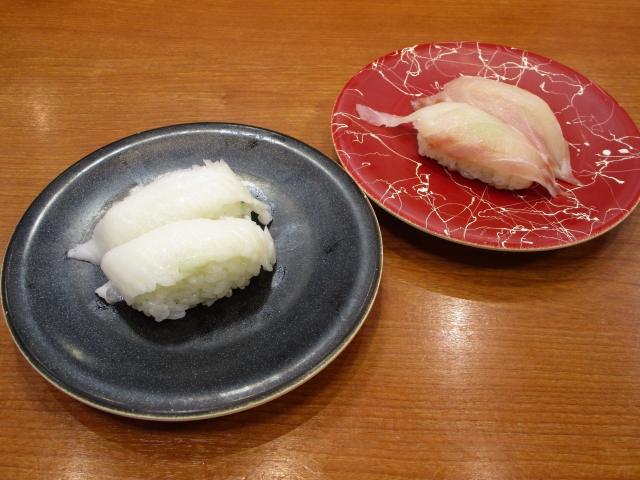
Nobu: “Now, as for how much the essential sushi toppings actually cost… the premise you need to remember is that ‘plate prices differ depending on the restaurant.’ So, that means you need to do some research in advance.”
Mike: “You mean researching the fish types and their prices?”
Nobu: “No, it’s necessary to know the types of plates and their prices. As I mentioned earlier, the red plates basically hold the cheap toppings. For example, it might be things like seaweed rolls (norimaki) or rolled omelet (tamagoyaki). Next, you should also know the price of the blue plates. For the middle class, the variety of nigiri sushi increases, so I think your sense of satisfaction will be different. Also, black plates are for high-end toppings. As you’d expect, these feature delicious items. That’s why they are expensive.”
Mike: “I see.”
Nobu: “And as for how to set a budget, there are probably various ways, but if it were me, I think it’s best to decide on a budget first and figure out how many plates to eat within that limit.”
John: “For example?”
Nobu: “For example, when you want to eat until you’re full on a 2000-yen budget, you can have about 10 of the cheap red plates and 4 blue plates. You give up on the black plates. By doing so, you can eat as many as 14 plates for 2000 yen. Conversely, if you want to ‘focus on eating delicious sushi,’ you go with 2 black plates and 6 blue plates. If you do that, it drops to about 8 plates, but you can focus on eating the delicious ones.”
Mike: “I see. That makes it easier to decide on a budget.”
Nobu: “However, checking the plate prices beforehand is extremely important. Please be careful, because making a mistake with the unit price can lead to serious trouble.”
Low-End Price Range (Around 120 Yen)
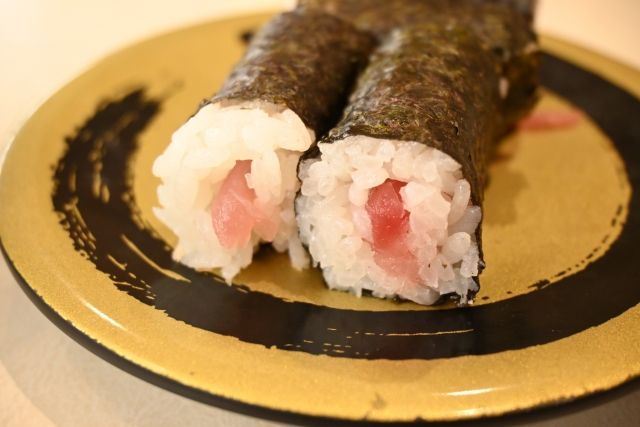
John: “So, could you tell me the specific prices of the sushi?”
Nobu: “Yes. The low-priced sushi around 120 yen primarily consists of seaweed rolls and inari sushi. Otherwise, even for battleship rolls (gunkan maki), things like corn are the main focus. There is also nigiri sushi, but it’s mostly relatively cheap toppings.”
John: “Could you give me a few specific examples of nigiri sushi?”
Nobu: “Yes. It will depend on the region and the restaurant, but there are shrimp, shellfish, and also squid. In some cases, items like bonito (katsuo) might also be included.”
Mike: “Even though it’s low price, there are many different varieties.”
Mid-Range Price Range (Around 200 Yen)
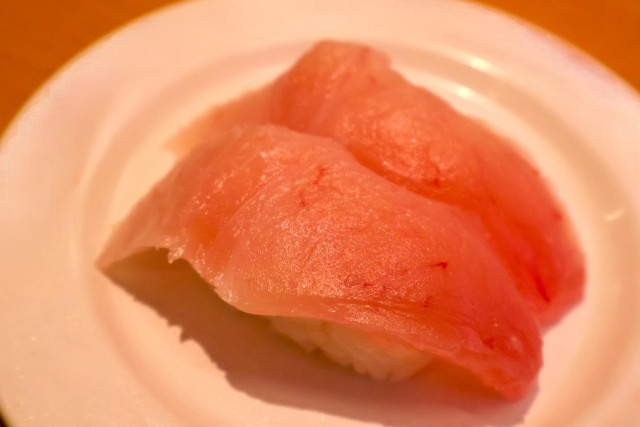
Nobu: “Next is the class around 200 yen. At this point, the variation of nigiri sushi increases. For example, yellowtail (hamachi), horse mackerel (aji), and salmon.”
John: “I see, so the variety increases. That sounds like it will be fun.”
High-End Price Range (400 Yen or More)
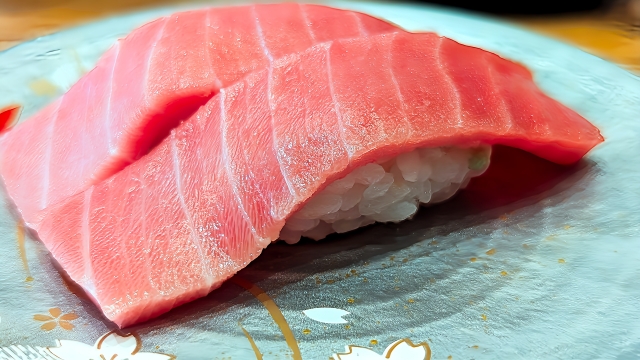
Nobu: “And then there are the high-end toppings. Things like salmon roe (ikura) and fatty tuna (toro) are included. These are delicious and popular parts.”
John: “Things get expensive when they become popular, after all.”
Nobu: “By the way, I divided the plates into 3 stages here, but depending on the restaurant, they might have 5 stages, or even 6 stages. It is necessary to research this first.”
John: “How do you research that?”
Nobu: “I think the quickest way is to check their website. They list the plate types, topping varieties, and prices, so I think it’s easy to set a budget. …However…”
John: “However?”
Nobu: “Recently, due to soaring prices, it seems that in some cases the sushi is smaller than it appears in the photos on the website.”
John: “That is a problem.”
Nobu: “Well, I hear that high-end sushi restaurants sometimes write ‘market price’ (jika). We probably just have to consider this to be better than that.”
Mike: “It can’t be helped. Well then…”
About Menus Other Than Sushi
Nobu: “By the way, conveyor belt sushi restaurants also sometimes have non-sushi menu items available.”
Mike: “For example?”
Nobu: “You can sometimes find things like fried chicken, french fries, and even cake.”
Kelly: “I see. In that case, it seems like even small children could enjoy it.”
Nobu: “That’s right. The whole family can enjoy it.”
The end.
From my own experience
This is a story from back when I was struggling financially. I probably should have been content with supermarket sushi, but since conveyor-belt sushi (kaiten-zushi) always tasted better to me, I had to figure out a way to make it work.
Naturally, I had to focus on the cheapest items on the menu. However, my “strategy” was to mix in a couple of slightly more expensive plates with the budget ones. This allowed me to stay relatively within my budget while still feeling full and satisfied.
At the sushi restaurant near my house, rolls were about 120 yen, while things like squid were around 200 yen. I would order five plates of rolls and two plates of squid, bringing the total to exactly 1,000 yen.
I remember that when I had a little more breathing room in my wallet, I’d allow myself a few more of those 200-yen plates. That said, no matter how much “extra” I had, I never touched the high-end, luxury sushi. My budget was always strictly set, and those premium plates were simply out of reach.
Conclusion
I have covered the restaurant systems, how to eat, and examples of prices regarding conveyor belt sushi.
Although the prices differ depending on the restaurant, the way to eat is common across them, so I think this will be a helpful reference for people coming to Japan.
At any rate, conveyor belt sushi is a type of sushi that is easy for ordinary people to enjoy, and I think it is an ideal genre for getting to know Japanese food culture.
Please enjoy conveyor belt sushi when you have the chance to visit Japan.
However, since the types of toppings available at conveyor belt sushi restaurants also differ by region, I think it is most interesting to travel across a wide area and eat your way around.
By all means, if you have the opportunity, please enjoy that kind of trip.
Recommended Article:
While this article focused specifically on conveyor belt sushi prices, there are plenty of other ways to enjoy sushi on a budget. The following article introduces various methods for getting cheap sushi, so please check it out!
Cheap Sushi in Japan: How Much Does Sushi Cost?