When you look at YouTube or other video sites, you often see Japan’s competitive eating culture. But has this always been a part of Japanese tradition? Actually, Japan has a long history of “big eating” contests, and “Wanko Soba” is its most iconic representative. However, it’s a bit different from your typical food challenge. What kind of soba is it, exactly?
Summary
Wanko Soba — The Endless Noodle Challenge
Experience one of Japan’s most unique dining traditions from Iwate Prefecture!
・The Experience: A fast-paced “all-you-can-eat” where servers toss noodles into your bowl with rhythmic chants.
・The Rule: It doesn’t end until you put the lid on your bowl—if you’re fast enough!
・The Origin: Born from the spirit of “Omotenashi” (hospitality) to ensure guests are always full.
・The Fun: Not just a meal, but an interactive “food sport” that tests your speed and appetite.
Characters
- Mike: A 12-year-old American boy interested in Japanese culture.
- John: Mike’s father, who travels to Japan for business.
- Kelly: Mike’s mother, an excellent cook.
- Nobu: A Japanese international student.
Prologue
In Japan, competitive eating shows are occasionally broadcast on TV and uploaded to YouTube. While the participants eat extraordinary amounts, this is actually a culture that has existed in Japan since ancient times. For example, in Rakugo (traditional comic storytelling), there is an episode called “Soba Wagering,” which features a soba-eating contest. The fact that it has been a staple of comedy for so long shows how deeply rooted this culture is in Japan.
One tradition of “big eating” that has been passed down for generations is “Wanko Soba.” And it comes with some very unusual rules. Let’s explore it through a story.
Japan’s All-You-Can-Eat Culture
Mike: “I’ve seen videos of Japanese all-you-can-eat restaurants and eating contests. Are those common?”
John: “Yes, the ‘all-you-can-eat’ (tabe-houdai) culture is quite common in Japan. You’ll find many places if you look around. Yakiniku (Japanese BBQ) is probably the most popular one.”
Mike: “That makes sense. With all-you-can-eat, you don’t have to worry about the bill. It’s great when you’re on a budget.”
John: “Exactly. I heard it’s very useful when going out with colleagues from work.”
Mike: “But has this been around for a long time?”
John: “I think so. Competitive eating has always been a thing. I’m sure it’s the same in Japan.”
Nobu: “Hello everyone!”
John: “Ah, perfect timing! We were just talking about all-you-can-eat culture in Japan. We see it in videos, but we wanted to know if it’s an old tradition.”
Nobu: “Well, while many modern all-you-can-eat restaurants appeared in recent times, there are traditional ones that have existed for centuries. ‘Wanko Soba’ is probably the best example.”
Mike: “Tell us more about that!”
What Kind of Soba is “Wanko Soba”?
Nobu: “There are many types of soba in Japan, like Tempura Soba or Tsukimi Soba (with a raw egg). But Wanko Soba is different. It’s not about what the soba is, but how you eat it.”
John: “What’s unique about the way you eat it?”
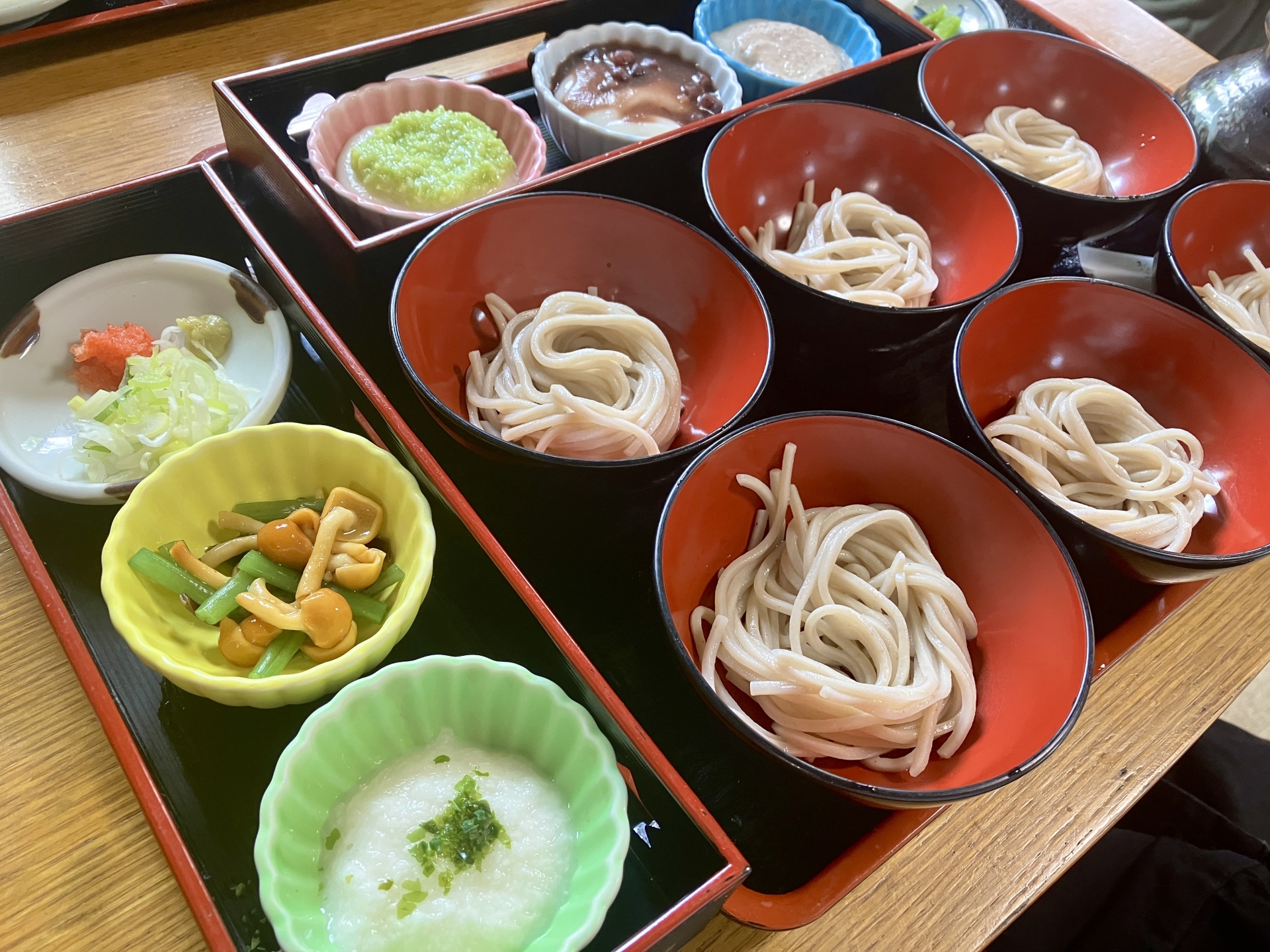
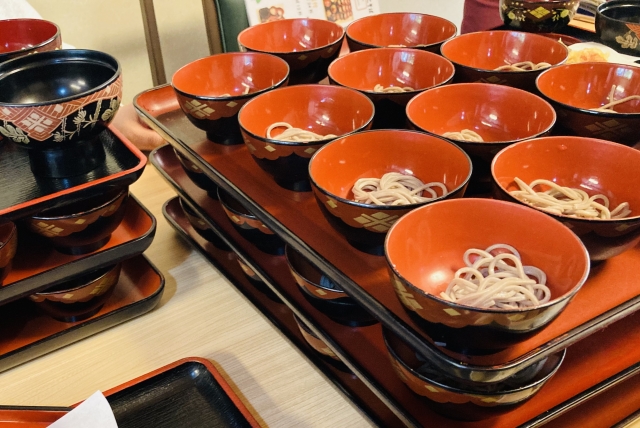
Nobu: “Usually, soba is served in a large bowl or on a bamboo tray (zaru). But Wanko Soba is served in tiny bowls, called ‘Wanko,’ with just a mouthful in each.”
Mike: “A tiny portion? And that’s all-you-can-eat?”
Nobu: “Exactly. But you don’t decide when you’re ready for the next bowl. A server stands right next to you. As soon as you finish one bowl, they toss the next serving into your bowl instantly. The speed is incredible—you just have to keep eating.”
John: “So it’s one bowl after another, without a break?”
Nobu: “Yes. That ‘next bowl’ keeps coming endlessly. Some people manage to eat over 100 bowls!”
Mike: “Wow, that’s amazing.”
Nobu: “But it doesn’t end there.”
John: “What do you mean?”
Nobu: “There’s a strict rule: to finish, you must close the lid of your bowl. If the server manages to throw in more soba before you can close the lid, you must eat it. And the servers are very fast!”
John: “So you eat until the server stops?”
Nobu: “Basically, yes. Most people want to stop when they’re full, but the server keeps coming. In the end, you practically have to plead with them to let you stop!”
John: “Can you eat Wanko Soba anywhere in Japan?”
Nobu: “Actually, it’s limited to a specific region: Iwate Prefecture in the Tohoku region.”
John: “How far is that from Tokyo?”
Nobu: “About three hours by Shinkansen (bullet train). It’s quite a trip, but for such a unique experience, it’s definitely worth the visit.”
The Soba Culture of Iwate Prefecture
Nobu: “By the way, did you know that the staple foods in Japan often depend on the local geography? This is especially true for Iwate.”
John: “I didn’t know that. I know the coast and the inland are different, but is there more?”
Nobu: “Japan’s land is divided into plains and mountains, and the crops grown in each are surprisingly different. In the plains, it’s easy to create rice paddies because they need flat land and plenty of water. Regions like Niigata and Miyagi are famous ‘rice bowls’ of Japan.”
John: “And what about the mountainous areas?”
Nobu: “In the mountains, you have to build terraces on slopes to hold water, which is a huge task. Securing a water source is also difficult. Therefore, it’s hard to grow rice.”
John: “So, they planted soba instead?”
Nobu: “Yes, in many cases. Iwate has many mountains and poor soil in some areas. Soba culture flourished there as a way for people to adapt to the land’s conditions.”
The Origins and Condiments
Mike: “How did Wanko Soba actually start?”
Nobu: “There are two main theories. One involves a feudal lord from centuries ago. When he was served local soba on his way to Edo (Tokyo), he enjoyed it so much that he kept asking for refills. Another theory is that it started when a famous politician from Iwate returned home and enjoyed it.”
Mike: “So it really does have a long history, unlike modern TV shows.”
Nobu: “Exactly. There’s even a national Wanko Soba competition now. Even children participate and eat an impressive amount!”
Kelly: “Does everyone just eat plain soba?”
Nobu: “No, Wanko Soba is served with various ‘Yakumi’ (condiments). Depending on the shop, you might get green onions, seaweed, grated daikon radish, or even tuna!”
Kelly: “That sounds wonderful. You can change the flavor as you go so you don’t get bored.”
Nobu: “True, but remember—the server won’t wait! You might be so busy trying to keep up that you barely have time to appreciate the condiments!”
From My Personal Experience
I used to live in Iwate Prefecture and have actually tried Wanko Soba several times. Iwate is famous for its delicious soba, and the noodles served in Wanko Soba are truly high-quality and flavorful.
However, because of the unique rules, it is surprisingly difficult to stop—even when you’re completely full! The servers can be a little “mischievous” and won’t let you quit easily. To finish, you have to put the lid on your bowl, but they are so quick that they’ll toss in more noodles before you can even move your hand.
Their speed is incredible; there was almost no time to close the lid! In the end, I had to literally beg them, saying, “Please, have mercy! I give up!” before they finally stopped.
While it is an “all-you-can-eat” experience, Wanko Soba has a unique element of “you MUST eat.” I highly recommend that travelers from overseas try it at least once. You might get to meet not only the “polite Japanese” people you expect but also a side of “playfully mischievous Japanese” culture!
Conclusion
Wanko Soba is more than just a meal; it’s an interactive experience rooted in Iwate’s history and geography. Whether you’re a fan of all-you-can-eat challenges or interested in how local landscapes shape food culture, it’s a must-try. Next time you’re in Japan, why not add a trip to Iwate to your itinerary? Just remember: be quick with that lid!