Sushi is often considered expensive, but sushi in Japan can actually be quite affordable. In this article, we explore how much sushi costs in Japan and where you can find cheap sushi.
【The Background Behind This Story】
Mike was a twelve-year-old boy from America who had recently developed a deep fascination with Japanese society. He enjoyed watching Japanese documentaries and travel shows, especially those featuring everyday life, local communities, and unique cultural traditions.
His mother, Kelly, who prided herself on being well-informed, often discussed news and social topics with him, though she admitted Japan’s social structure was more complex than she expected.
His father, John, was a busy corporate worker who had traveled to Japan many times but rarely experienced life outside business districts in big cities.
They also knew Nobu, a Japanese college exchange student who often visited their home and shared stories about school life, customs, and regional differences.
Mike liked Japan, and he realized there was still so much more to learn about the country’s diverse and evolving society.
How to eat sushi cheaply: Prologue
Sushi is a high-class dish. Sushi that is ordered and made by the master while sitting at the counter can be said to be especially expensive.
Therefore, even for Japanese people, sushi restaurants are hard to enter.
However, although sushi restaurants are expensive, if it is just for the purpose of eating sushi, it is not as if there are no ways to make it cheaper.
The taste might be inferior to a sushi restaurant, but there is sushi you can eat if you devise a plan. So, here, let’s introduce methods to eat sushi cheaply in Japan.
Act 1: Nobu introduces cheap sushi
John: “When I went to Japan, I entered a sushi restaurant, and it was indeed authentic sushi. There was no sushi as delicious as that.”
Mike: “Wow, that’s amazing. I want to eat sushi in Japan too.”
Nobu: “Hello.”
John: “Hey, Nobu. We were just talking about Japanese sushi.”
Nobu: “That’s nice. In Japan, I also ate sushi for lunch. It was about 400 yen, I think.”
John: “Hey, what did you just say?”
Nobu: “Yes, I said I ate sushi for about 400 yen.”
John: “The sushi I ate in Japan was about 8000 yen. What does that difference mean?”
Nobu: “I see, you went to a sushi restaurant. In that case, it gets expensive.”
John: “Isn’t sushi something you eat at a sushi restaurant?”
Nobu: “Yes, that’s right. Sushi is at a sushi restaurant. However, you can eat sushi outside of sushi restaurants too. Although, the taste will probably drop.”
Mike: “Let me hear more about that.”
Nobu: “Understood.”
The cheapest method to eat
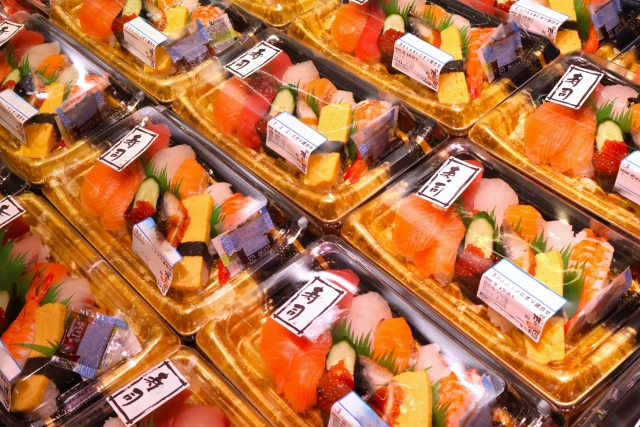
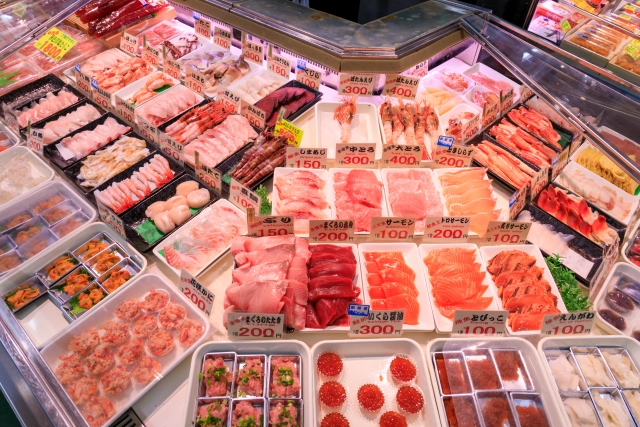
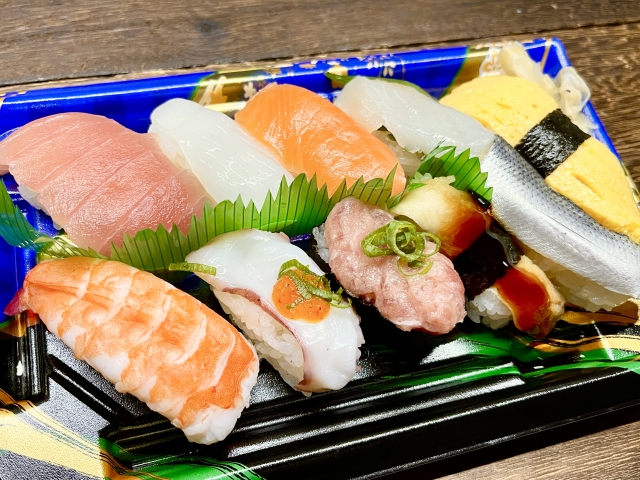
Nobu: “The cheapest way to eat is, as expected, the sushi sold at supermarkets, I think. It depends on the supermarket, but they generally sell it for 400 yen or 500 yen.”
John: “400 yen or 500 yen??? Over here, isn’t that more than double the price?”
Kelly: “That’s right. Prices like 400 yen or 500 yen are exceptionally cheap.”
Nobu: “By the way, supermarkets do discount sales as it gets close to evening.”
Kelly: “Discount sales, how much does it drop?”
Nobu: “20% or 30%. In some cases, it even drops to half price.”
Kelly: “I can’t believe it drops that much.”
Nobu: “Sushi and sashimi have to be sold within the day, so they sell it even if they make it cheaper. But since the competition rate for discounted ingredients increases, it also becomes harder to buy.”
Kelly: “That makes sense.”
Nobu: “By the way, much of the sushi sold in Japanese supermarkets is nigiri sushi. There are also many norimaki (seaweed rolls) and temaki (hand-rolled) sushi, but there is a lot of nigiri sushi too.”
John: “I see, Japan is different.”
The second cheapest method to eat
Nobu: “Next is the second cheapest method to eat sushi, but it’s probably sushi at convenience stores. I think it’s maybe 500 yen or 600 yen.”
John: “Oh, there’s sushi even at convenience stores. But as expected, sushi at Japanese convenience stores is cheap.”
Nobu: “In the past, since many convenience stores are open 24 hours, they didn’t have closing discounts like supermarkets. But recently, to reduce food loss, many convenience stores have started offering discounts on items nearing their expiration dates.”
Kelly: “But it’s cheap either way. It’s attractive.”
The third cheapest method to eat
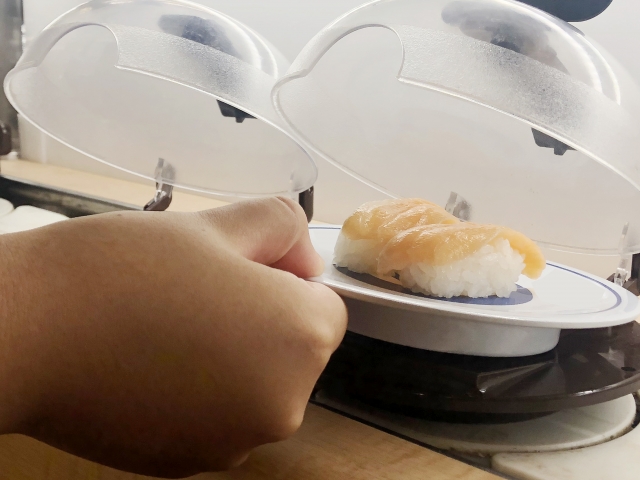
Nobu: “Next is the third. I think the third will be kaiten-sushi (conveyor belt sushi).”
Mike: “Kaiten-sushi. I know about that.”
Nobu: “But I think the price is different. Because it starts from about 120 yen or 150 yen for two pieces. Therefore, hypothetically even if you ate about 10 pieces on 5 plates, I think it would be done with about 800 yen. Well, if it’s a man, they might eat about 10 plates, so 1500 yen or 2000 yen would be necessary.”
John: “But even so, it’s cheap.”
Slightly Expensive Sushi vs. Seriously Expensive Sushi
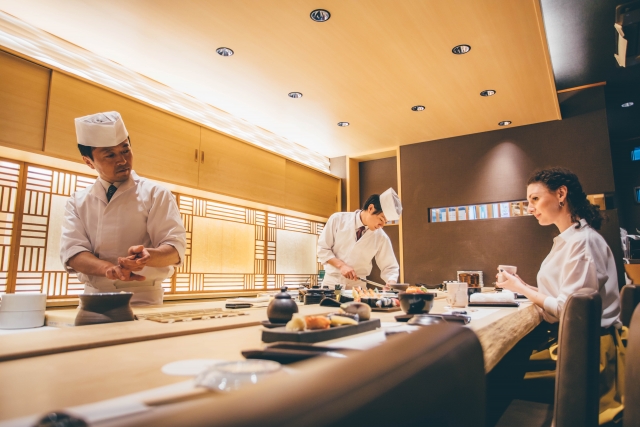
Nobu: “I’ll introduce a sushi course meal here. It’s a bit different from a dedicated sushi restaurant, but there are cases where izakayas (Japanese pubs) serve sushi as well. It depends on the shop, but you can eat for around 5,000 to 8,000 yen.”
John: “Even that might be cheap.”
Nobu: “Well, for the most high-end sushi, there are places that cost over 30,000 yen.”
Kelly: “Aren’t there any shops that are delicious and cheap?”
Nobu: “Not just limited to sushi, but prices tend to go down as you move away from urban areas. I don’t know if they have high-end sushi there, but I think it gets cheaper if you go to the countryside.”
John: “Maybe that’s the spot to aim for?”
Nobu: “I think it’s a case-by-case basis. It might end up being expensive if you include transportation costs. However, it might be good if you’re traveling leisurely through the countryside. Also, port towns with a thriving fishing industry would be nice.”
John: “I see.”
Act 2: Why is it so cheap… Kelly is surprised by the reason
Kelly: “But why can you eat it that cheaply? I’m curious about the reason.”
Nobu: “I think there are various reasons, but firstly, I think the distribution volume of raw fish is different. A quite common case is processing fish at the supermarket. Specialized craftsmen are in the supermarket, processing raw fish into sashimi. Because of that, you can eat fresh sashimi.”
Kelly: “I see. It’s the same for sushi then.”
Nobu: “Also, it might depend on the number of craftsmen. In the case of overseas, craftsmen are limited, so it becomes that much more expensive. In that regard, there are many craftsmen in Japan, so prices might be prone to dropping more easily.”
Kelly: “I can imagine that too.”
Nobu: “By the way, Japan has what you could call a massive fish market.”
Kelly: “Where is that?”
Nobu: “It’s a town called Toyosu in Tokyo.”
John: “Toyosu, huh. I’ll remember that.”
Act 3: There are regional differences in kaiten-sushi too
Nobu: “By the way, I think you know that Japan has many fishing ports, but did you know that different fish are caught at each fishing port?”
John: “Japan has a small land area, but it’s surrounded by the sea on all four sides, so I can imagine that being the case.”
Nobu: “Yes. There is the Pacific Ocean side and the Sea of Japan side. Also, there are distinctions like deep-sea fishery and coastal fishery. The fish are different depending on that.”
John: “I see, there are distinctions like that too.”
Nobu: “Yes, and in such towns, even kaiten-sushi restaurants sometimes procure delicious fish. Therefore, it is also possible to eat kaiten-sushi unique to that town.”
Act 4: Mike yearns for a journey to eat sushi
Mike: “Then, if you go all the way around Japan, can you eat various kinds of sushi?”
Nobu: “I don’t know about the probability, but I think it’s possible. For example, because I think the fish caught in Hokkaido and the fish caught in Kyushu are different.”
Mike: “I see. Then, you just have to go to a town with delicious fish and look for kaiten-sushi.”
Nobu: “Actually, that might be a little difficult too. In the case of kaiten-sushi restaurants, there are quite a few cases where major chain stores are operating. In such cases, they don’t necessarily serve local fish. So, even if you look for kaiten-sushi, you might have to gather information.”
Mike: “That sounds difficult then.”
Nobu: “Well, if your stay in Japan is long, the situation might change too.”
Mike: “I see. But I long for it. An eating tour journey in Japan.”
John: “I bet.”
End
Conclusion
As mentioned at the beginning, sushi is a high-class food even in Japan. Therefore, ordinary people cannot eat it easily. However, there are ways to eat it cheaply.
In addition to that, there are regional differences in sushi. That is the same even for kaiten-sushi. If you go a little further, you might encounter sushi you didn’t know. In any case, I think the best way to know a culture is by interacting with it.
If you come to Japan, daring to eat cheap sushi might also be good. I think knowing the dietary life of ordinary Japanese people is also meaningful in knowing the culture.
Recommended Article
While this article focused on how to enjoy sushi at a low cost, the next one introduces Japanese supermarkets.