Mike was a twelve-year-old boy from America who had recently developed a deep fascination with Japanese society. He enjoyed watching Japanese documentaries and travel shows, especially those featuring everyday life, local communities, and unique cultural traditions.
His mother, Kelly, who prided herself on being well-informed, often discussed news and social topics with him, though she admitted Japan’s social structure was more complex than she expected.
His father, John, was a busy corporate worker who had traveled to Japan many times but rarely experienced life outside business districts in big cities.
They also knew Nobu, a Japanese college exchange student who often visited their home and shared stories about school life, customs, and regional differences.
Mike liked Japan, and he realized there was still so much more to learn about the country’s diverse and evolving society.
Prologue
Japan’s culture of eating fish is well-known worldwide. While sushi and sashimi are famous, it is said that hot pot dishes (nabe) have also recently been introduced abroad.
As someone who wants people to know about Japanese culture, this makes me very happy.
However, Japan also has a rather unusual—or perhaps “extraordinarily strange”—culture of eating fish. Here, I would like to highlight one such example. In fact, Japan and a few surrounding areas are likely the only places in the world where this fish is eaten. I will reveal the name of the fish later for you to look forward to.
Act I: Kelly is Shocked to Hear About Fugu Culture
Kelly: “Japan’s culture of eating fish is so interesting. They really know ways of eating that we’ve never even heard of. I never knew how delicious it was to eat fish in a hot pot on a cold winter day.”
Mike: “Exactly. It feels like a completely different world compared to fast food like fish and chips.”
Kelly: “It really is. But there are still many Japanese fish cultures we don’t know about, right?”
John: “Yeah, that’s right. It seems they serve parts of the fish that you wouldn’t find in a Japanese restaurant in America.”
Kelly: “For example, like what?”
John: “A good example would be the head—the fish’s head.”
Kelly: “The head? Is there actually anything to eat on a fish head?”
John: “Apparently, there’s surprisingly a lot. I hear the area around the eyes is especially delicious. It has a jelly-like texture and a very unique flavor.”
Kelly: “Just hearing that makes my head spin. I always thought the head was just something you throw away.”
Mike: “But I bet they eat even more amazing things—parts that we would absolutely never eat.”
John: “Maybe so. Let’s ask Nobu next time he visits.”
Act II: Nobu Introduces a Certain Fish; Kelly Faints?
Nobu: “Hello.”
Kelly: “Oh, hello. We were just talking about you.”
Nobu: “Did I do something?”
Kelly: “No, we wanted to ask you about Japanese fish-eating culture.”
Mike: “Right. Japanese people eat some shocking things. My mom almost collapsed when she heard people eat fish heads.”
Nobu: “Haha, fish heads are commonly served in restaurants and even sold in supermarkets. It’s just a popular part of the fish.”
Kelly: “That’s what I find unbelievable—cooking and eating parts that we would throw away.”
Nobu: “But it’s delicious. You should try it if you get the chance.”
Kelly: “Yes, I’ll do that.”
Mike: “By the way, do Japanese people eat any fish even more ‘extreme’ than that?”
Nobu: “There is one. It’s…”
Mike: “It’s…??”
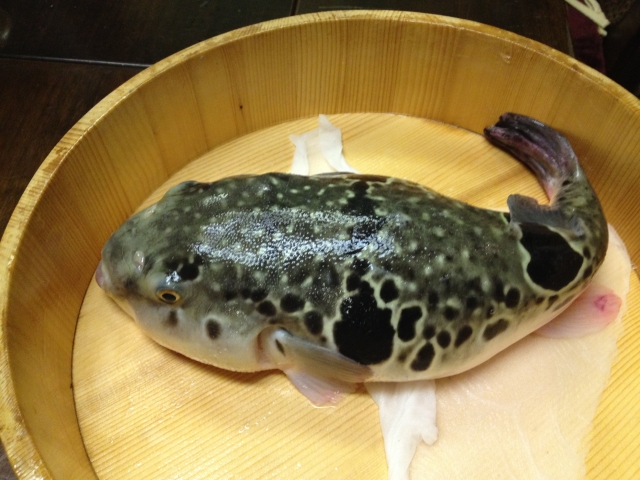
Nobu: “Fugu (Pufferfish).”
Mike: “Wait a second, isn’t fugu… “
John: “Isn’t fugu a fish with deadly poison?”
Nobu: “Yes, it is. The ovaries, in particular, are said to be incredibly toxic. Also, there’s a popular saying in Japan where fugu was called ‘Teppo’ (Rifle).”
Mike: “Why ‘Rifle’?”
Nobu: “Because if it ‘hits’ you (if you get poisoned), you die.”
John: “That’s a pretty dark joke, but it’s scary because it’s actually true.”
Nobu: “Even so, fugu is commonly eaten in Japan. Though you’ll never see it sitting on a regular supermarket shelf.”
John: “That makes sense. It would be way too dangerous for an average person to handle a fish like that.”
Nobu: “Exactly. Preparing fugu requires a special license. Since you have to cook it while avoiding the poison, it requires specialized techniques.”
Kelly: “I see. That makes me feel a bit better.”
Act III: John Is Conflicted; Kelly Faints
Kelly: “Well then, let’s have John eat fugu when he goes to Japan.”
John: “Whoa, wait a minute. I trust the Japanese, but I need some mental preparation before eating fugu.”
Nobu: “But it’s so good.”
Kelly: “Just out of curiosity, how is it usually eaten?”
Nobu: “There are many ways. The most popular are sashimi and hot pot. Well, it’s a luxury food, so it’s a bit out of my price range.”
John: “Hearing about sashimi and hot pot actually makes me want to try it.”
Nobu: “If you’re going to eat fugu, I recommend going to a region famous for it.”
John: “A region famous for fugu? Where would that be?”
Nobu: “Yamaguchi Prefecture. The city of Shimonoseki is very famous for fugu.”
John: “How do I get there?”
Nobu: “Yamaguchi is the westernmost part of Honshu. I recommend taking the Shinkansen (bullet train). However, Japan is a long country from east to west, so even with the Shinkansen, it takes several hours.”
John: “That can’t be helped. I’d want to go even if I have to make the time.”
Kelly: “Oh, John, are you actually planning to go?”
John: “Yeah, if the Japanese are eating it, we’ll be fine too.”
Nobu: “Oh, I just remembered one more thing. Since you’re going all that way, you should try this too.”
John: “What is it? Something even more interesting?”
Nobu: “Should I say it? I feel like Kelly might actually faint.”
Kelly: “What is it? Just tell me!”
Nobu: “Actually, there is a region where they eat fugu ovaries.”
Kelly: “…… “
Nobu: “In Ishikawa Prefecture, there’s a food called ‘Fugu no Ranso no Nukazuke’ (Fugu Ovaries Pickled in Rice Bran). They ferment them for about three years to detoxify them. It’s a traditional dish of Ishikawa. Apparently, this specific region is the only place in Japan allowed to manufacture it… “
John: “Nobu, you don’t need to explain anymore.”
Nobu: “Oh, why not?”
John: “Kelly fainted.”
Regions That Eat Fugu
People who eat fugu are a very small minority in the world. It seems to be limited to the Japanese and some parts of Asia.
Considering how toxic fugu is, this is perhaps understandable. I’ve heard that fugu poison is incredibly powerful, on par with potassium cyanide. I truly admire the wisdom and courage of our ancestors.
On a personal note, I often think that the courage of the second or third person to ever eat fugu must have been extraordinary. I say this because while the first person undoubtedly died, the second or third person might have eaten it knowing full well that the first person had died. Were they fugu experts, or just incredibly daring challengers? It’s something that makes me wonder.
Fugu Consumption and the Japanese
So, when did Japanese people start eating fugu? Apparently, it has been thousands of years. Fugu bones are often found in ruins in regions where fugu consumption is popular. These appear to be the remains of fugu eaten by ancient people.
However, fugu can be caught in other regions as well. For example, they are said to inhabit the coasts of South Korea and China, but it seems they are not eaten as extensively as in Japan. Japan seems to be the only place where eating fugu has truly become a part of the culture.
By the way, I once heard that a foreign Prime Minister once ate fugu in Yamaguchi Prefecture. Perhaps as a head of state, he couldn’t refuse, but he must have been quite worried.
Can You Eat the Poisonous Parts?
As mentioned in the story, the answer to “Can you eat the poisonous parts?” might seem to be “Yes,” but that is a “rare among rares” case.
Basically, the answer should be “No”. In fact, even among Japanese people, these specific dishes are only known by those “in the know”. Most Japanese people would be shocked to hear about them for the first time (I certainly was!). As mentioned before, ordinary people cannot prepare fugu. It is only possible with a special qualification for fugu preparation. Even if you happen to catch one while fishing, absolutely do not try to eat it yourself.
Fugu Cooking Examples
Here are some typical fugu dishes.
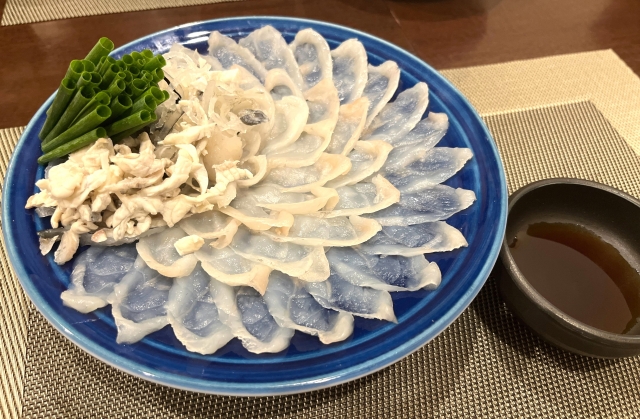
Sashimi
This is the most orthodox way to eat fugu. It is characterized by being sliced very thin, has a firm elasticity, and a delicate, light flavor. It is typically enjoyed with ponzu sauce and various condiments.
Fugu Nabe (Hot Pot)
Also known as “Fugu-chiri,” this is a hot pot dish where fugu meat and vegetables are simmered in a broth made from kelp (konbu). After eating the main ingredients, you can add rice to the broth to enjoy it as “Fugu Zosui” (pufferfish rice porridge).
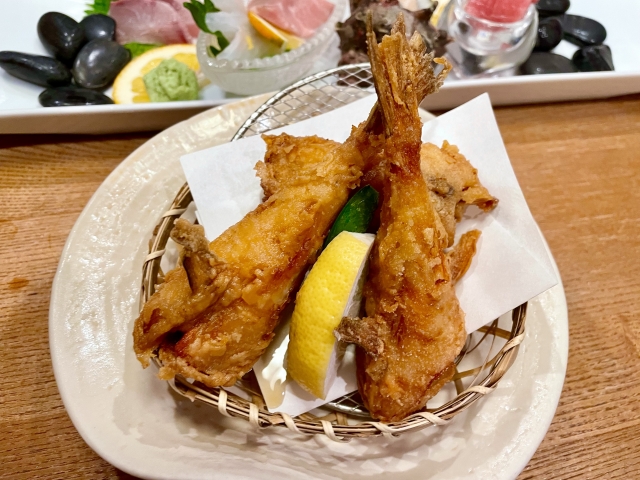
Karaage (Deep-fried)
Fried fugu is also a staple dish. Chunks of fugu meat are lightly coated and deep-fried. It is usually eaten with salt or ponzu sauce.
Cities Where You Can Eat Fugu
Basically, fugu can be eaten in various regions across Japan, especially in large cities. From what I’ve found, there are restaurants serving it from Tokyo all the way to Hokkaido. Tokyo and Osaka also have many excellent fugu restaurants.
However, if you are coming all the way to Japan, I would love for you to experience authentic fugu cuisine. For that, I highly recommend Yamaguchi Prefecture, which is famous for its fugu.
Incidentally, Yamaguchi Prefecture produced many influential figures who were active during the Meiji Restoration. It is a city that history buffs might also find very enjoyable.
Conclusion
I’ve introduced the Japanese culture of eating fugu. Many of you might think, “What a strange people,” knowing that they eat such a toxic fish. To be honest, I sometimes think we are a “strange people” myself. When my family gathers around the dinner table, we often talk about how incredible the first family to ever eat fugu must have been.
In any case, I believe there are still many aspects of Japanese culture that haven’t been widely introduced abroad. I plan to continue sharing interesting cultural facts, so please stay tuned!