Mike was a twelve-year-old boy from America who had recently developed a deep fascination with Japanese society. He enjoyed watching Japanese documentaries and travel shows, especially those featuring everyday life, local communities, and unique cultural traditions.
His mother, Kelly, who prided herself on being well-informed, often discussed news and social topics with him, though she admitted Japan’s social structure was more complex than she expected.
His father, John, was a busy corporate worker who had traveled to Japan many times but rarely experienced life outside business districts in big cities.
They also knew Nobu, a Japanese college exchange student who often visited their home and shared stories about school life, customs, and regional differences.
Mike liked Japan, and he realized there was still so much more to learn about the country’s diverse and evolving society.
Introduction: The Land of Four Terrors
Japan is a beautiful archipelago, but it is also a land shaped by the relentless forces of nature. From massive earthquakes that shake the very foundation of the earth to powerful typhoons that bring torrential rain and wind, the Japanese people have coexisted with natural disasters for centuries.
There is an old Japanese saying that lists the four most terrifying things in life: “Jishin, Kaminari, Kaji, Oyaji”・Earthquakes, Thunder, Fire, and… Father. This list ranks these “terrors” in order of their perceived threat, with earthquakes standing as the ultimate fear.
While it’s a bit of a joke today that fathers have become less “scary” than they used to be, the order of the first three remains a stark reminder of the trials Japan has faced.
However, Japan has not just endured; it has innovated. Today, Japanese architecture is world-renowned for its resilience.
Act I: A Father’s Disbelief
John, an American living in Japan, sat staring at his laptop screen, his face a mix of awe and concern.
“Wow… looking at this again, the scale of natural disasters in Japan is just staggering,” John muttered to himself.
His 12-year-old son, Mike, walked into the room. “What are you looking at, Dad?”.
“I found some videos of past Japanese earthquakes,” John replied, turning the screen toward Mike. “Look at the intensity of the shaking. Items are flying off the shelves, and furniture is sliding across the room… it’s chaotic. It makes me wonder how people can even live here peacefully”.
Mike watched for a moment, then frowned. “I was thinking the same thing. If an earthquake like that hit us back home, wouldn’t the whole city be in ruins? It’s scary to think about houses collapsing”.
John nodded slowly. “That’s the strange part. Even in these extreme videos, you see the buildings swaying violently, but so few of them actually fall down. It’s truly surprising when you think about it”.
Act II: Nobu’s Lesson in Engineering
Just then, Nobu, a Japanese exchange student staying with them, entered the room.
“Hello there! We were just discussing how incredible it is that Japanese buildings stay standing,” John said.
Nobu smiled. “It’s a fascinating topic. In Japan, we build survival systems, not just houses. I can explain a bit about how it works”.
The Triple Shield of Earthquake Protection
“Japanese buildings are designed with three distinct structural philosophies to handle seismic energy,” Nobu explained.
Seismic Resistant Structure (Taishin): This is the foundation of Japanese safety. The main pillars, beams, and walls are heavily reinforced to endure the shaking without breaking.
Base Isolation Structure (Menshin): This is like putting the building on cushions. Special rubber devices are placed at the foundation to absorb the earth’s movement, so the building itself hardly shakes.
Seismic Control Structure (Seishin): We install ‘dampers’・essentially giant shock absorbers・inside the walls to soak up vibration energy and control the sway.
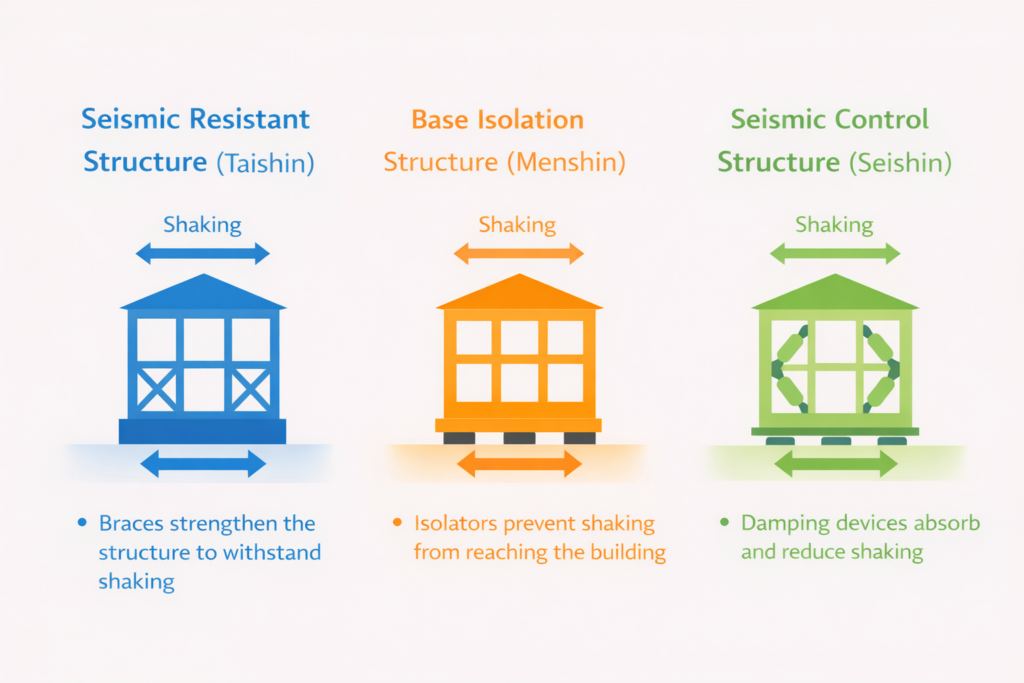
“By combining these technologies, buildings can survive not just minor tremors, but significant quakes,” Nobu said. “In some cases, engineers even build full-scale houses on massive ‘shaking tables’ to simulate real earthquakes and prove they won’t fall”. Mike looked amazed, unable to even imagine such a large-scale experiment.
Calculating the Wind: The Battle Against Typhoons
“What about those massive typhoons?” Mike asked. “The wind looks strong enough to blow anything away”.
“For typhoons, it’s all about high-level physics,” Nobu replied. Architects use complex formulas derived from historical data of the most powerful storms. They calculate wind direction, ground conditions, and even the specific shape of the building・whether it’s a square tower or a rounded dome.
“A flat wall takes the wind head-on, while a sloped roof experiences different pressures,” Nobu continued. “Every single angle is accounted for in the safety calculations to ensure the wind doesn’t rip the structure apart”.
Act III: Tips for Living in Japan
“So, if I move to Japan, I’ll be safe anywhere?” Mike asked excitedly.
Nobu held up a finger. “Not necessarily. You have to know when the building was built”. He explained that Japan’s building codes evolved alongside its disasters. The most significant turning point was 1981, when the ‘New Anti-Seismic Design Code’ was introduced.
Pre-1981 Buildings: These were built under older, more relaxed standards and may be more vulnerable to damage.
Post-1981 Buildings: These follow much stricter safety rules and are generally safer.
Seismic Retrofitting: Even older buildings can be safe if they have been reinforced later with steel frames or dampers.
“When you’re looking for an apartment in Japan, checking the ‘building age’ (Chikunensu) is vital for your safety,” Nobu advised.
Going Beyond the Basics: The Details That Save Lives
The technology goes even deeper than the skeleton of the building.
The ‘Anti-Warp’ Doors
In an earthquake, a building’s frame can shift and deform, jamming doors shut and trapping people inside. To prevent this, Japanese apartment doors are designed with ‘seismic performance’.
Engineers use machines to warp door frames with immense force to ensure the door can still be opened even when the frame is twisted, allowing for a smooth evacuation.
Water and Wind Testing
For typhoons, doors and windows undergo two rigorous tests. The first ensures that rain won’t leak inside even during a torrential downpour. The second ensures the glass and frames won’t shatter under extreme wind pressure.
Fireproofing: The Trial by Flame
Fire is a secondary disaster that often follows earthquakes. Modern Japanese homes are wrapped in non-combustible materials to prevent fire from spreading between buildings.
Materials are either designed to strict standards or put through actual fire-heating tests to confirm they won’t fail. Only materials that pass these extreme trials are used in construction.
Technology is a Collection of Small Wonders
When you see a Japanese skyscraper, it looks like a marvel of high-tech engineering. And it is・countless complex and specialized calculations are involved in every project. But where does this technology come from?.
Actually, it stands on a foundation of very “modest” and “unseen” work. It’s the result of testing how much force it takes to snap a single bolt or exactly how much a steel plate can stretch before it tears. Much of this research and experimental work happens in small, local workshops across the country.
Without the precision and dedication of these “town factories,” the seismic safety of a giant skyscraper could not be guaranteed. While we admire big construction companies, the craftsmen in local workshops deserve equal praise.
If you ever get the chance to have a meal with the owner of a small Japanese factory, take it. If you can get them to share their experiences, they might tell you stories of engineering feats and precision work that will blow your mind.
Conclusion: The Mystery of the Past
Today, we have supercomputers and advanced software to calculate every vibration. But as Nobu pointed out, there is a mystery that even modern engineers find humbling: Japan’s historical structures like ancient pagodas and castles.
These wooden structures have stood for hundreds of years, surviving countless quakes and storms without the help of modern software or computers. It makes you wonder・did the people of the past possess a deeper understanding or a superior ability to work with nature compared to us today?.
Whether it’s a high-tech skyscraper in Tokyo or a 400-year-old castle, Japan’s architecture is a testament to human resilience and the relentless pursuit of safety.